

From Ideation to Operationalisation: The Evolution of a Fully Structured Carbon Market in Nigeria1
Introduction
As global efforts continue to address greenhouse gas (GHG) emissions, Nigeria has set an ambitious target to achieve net zero by 2060, aiming to equalise the amount of GHG emitted with the amount removed. The country's Energy Transition Plan ("ETP") provides a tailored, phased approach to reach this objective.2 However, the scale of financial capital required to achieve this target is substantial, estimated at $410 billion above business-as-usual spending, with significant front-loaded investments needed by 2040.
In response, Nigeria, as a party to the Paris Agreement,3 is moving away from traditional funding models and adopting economic strategies to unlock and access new climate finance sources and support emission reduction in its Nationally Determined Contribution ("NDC") priority sectors, such as agriculture, power, industry, oil and gas, and transport.4 The evolution of a carbon market in Nigeria is one of such strategies being adopted.
The enactment of the Climate Change Act 2021 (the "CC Act"), the launch of the Carbon Market Activation Plan ("CBAP"), the operationalisation of the Climate Change Fund ("CCF"), the restoration of the National Council on Climate Change ("NCCC") to the budget line,5 and the recent approval by the Federal Government of Nigeria of the adoption of a National Carbon Market Framework ("NCMF"), collectively transition the national carbon market from ideation to operationalisation.
Although the NCMF had been under development prior to its public unveiling by the Federal Government of Nigeria at the Abu Dhabi Sustainability Week 2026,6 its presentation served as the first major international articulation of Nigeria's structured carbon market architecture, thereby positioning Nigeria within the evolving global carbon finance ecosystem and signalling to international investors, host governments, and carbon market intermediaries, of Nigeria's sovereign commitment, regulatory intent, and institutional preparedness to participate in international cooperative approaches for climate change frameworks.
Taken together, these developments represent a significant turning point in Nigeria's climate policy trajectory. With comprehensive legislative and institutional structures established, Nigeria is positioned to advance from theoretical dialogue to tangible action. By activating these frameworks, Nigeria seeks to enhance investor confidence and attract the necessary green capital to support its energy transition and broader climate objectives, and to establish itself as a trusted participant in the evolving international carbon market framework.
This article examines the emerging carbon market architecture in Nigeria and outlines the obligations and opportunities for project developers and investors operating within this framework.
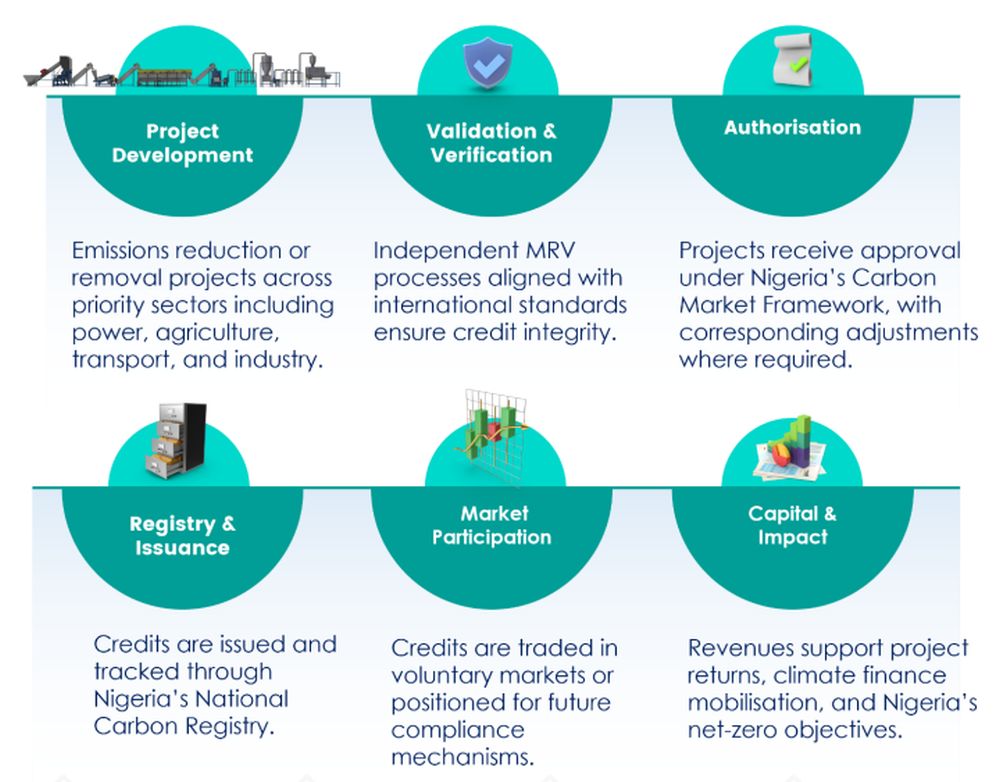
The Global Carbon Market Architecture
Carbon markets are structured trading systems designed to facilitate the reduction of GHG emissions through measurement, pricing, and exchange mechanisms. The global carbon market structure is designed to create financial incentives that make emission reductions economically attractive, by assigning a price to GHG emissions generated by operators in the industrial sector, and encouraging innovation, efficiency and the deployment of cleaner technologies in operational carbon markets.
These markets take two primary forms: (i) mandatory or compliance systems; and (ii) voluntary market systems. The former requires regulated entities to participate and meet legally established reduction targets, while the latter allows organisations to purchase credits, to compensate for emissions beyond regulatory requirements. Carbon markets also vary in scope, with some operating at the regional or national level,7 while others facilitate cross-border or international trading under frameworks such as Article 6 of the Paris Agreement. Although their structures differ, all carbon markets serve the same overarching purpose of reducing GHG emissions by directing capital toward mitigation activities.
They also comprise a network of public and private actors involved in the development, certification, trading, and oversight of carbon credits. Key participants include project developers who originate emissions reduction or removal projects; independent validators and verifiers responsible for measurement, reporting, and verification (MRV); registry operators that issue, track, and retire carbon credits; and buyers, such as corporations and financial institutions, seeking credits for compliance or voluntary climate commitments. Intermediaries, such as brokers, exchanges, and aggregators help facilitate market liquidity and price discovery, while regulators and designated national authorities provide policy direction, licensing, and compliance supervision. Supporting actors such as host communities, financial service providers, and international standard-setting bodies further shape the ecosystem by ensuring project bankability, social safeguards, and alignment with national and international climate frameworks.
The Nigerian Carbon Market Framework
The regulation of Nigeria's carbon market is now primarily premised on compliance mechanisms provided under the NCMF, aimed at ensuring transparency in carbon credit issuance and transactions, accountability of market participants for accurate reporting and regulatory compliance, and environmental integrity through the verification of genuine, additional, and non-duplicative emissions reductions in a manner that is consistent with Nigeria's climate commitments.
The NCMF is designed to establish a coherent legal and institutional framework for the generation, authorisation, transfer, and accounting of carbon credits for qualified projects in Nigeria. It is structured to mobilise climate finance at scale by providing regulatory clarity and predictable procedural pathways capable of unlocking private capital flows into priority sectors identified under Nigeria's NDCs. Beyond market activation, the NCMF adopts a phased design, using voluntary market participation as an entry point, while signalling a progressive transition toward a domestic compliance regime, including the potential development of an emissions trading system and carbon pricing instruments.
To view the full article, click here.
Footnotes
1 Click here to see our initial article, "The Nigerian Carbon Market: Still in Ideation?", where we highlight some of Nigeria's efforts and initiatives towards the establishment of a carbon market.
2 The ETP was issued in 2022 and is anchored on five key sectors: Power, Transport, Cooking, Industry, and Oil & Gas, all of which collectively account for approximately 65% of the nation's total GHG emissions.
3 The Paris Agreement is a legally binding international treaty on climate change. It was adopted by 195 Parties at the UN Climate Change Conference (COP21) in Paris, France, on 12 December 2015. It entered into force on 4 November 2016.
4 The NDCs are commitments made by countries to reduce greenhouse gas emissions and adapt to climate change.
5 Punch Newspaper, FG Approves National Carbon Market Framework to Unlock $3bn Annually. Available at https://punchng.com/fgapproves-national-carbon-market-framework-to-unlock-3bn-annually/. Accessed 18 December 2025
6 The Abu Dhabi Sustainability Week 2026 held from January 11 to 17, 2026. The theme, "The Nexus of Next: All Systems Go," focused on collaboration across various sectors to drive sustainable development globally.
7 For example, the Lagos State Carbon Exchange, which was unveiled in March 2025.
The content of this article is intended to provide a general guide to the subject matter. Specialist advice should be sought about your specific circumstances.
[View Source]