

Court finds that expressly true “Was/Now” discounts were misleading to consumers: ACCC v Coles Supermarkets Australia Pty Ltd [2026] FCA 598
Introduction
On 14 May 2026, the Federal Court of Australia delivered judgment in Australian Competition and Consumer Commission v Coles Supermarkets Australia Pty Ltd [2026] FCA 598, which is a hugely significant decision concerning the lawfulness of ‘was/now’ comparative pricing in supermarket promotions.
Justice O’Bryan found that Coles Supermarkets Australia Pty Ltd had contravened ss 18(1) and 29(1)(i) of the Australian Consumer Law (ACL) by offering products on its well-known ‘Down Down’ promotional program with price tickets that conveyed misleading representations about the genuineness of the discounts offered. The decision arose from proceedings brought by the Australian Competition and Consumer Commission (ACCC) and a parallel representative proceeding (class action) commenced by Mr Benjamin Demery on behalf of consumers who purchased the affected products.
Background
Between February 2022 and May 2023, the ACCC alleged that Coles temporarily increased the retail prices of 245 packaged grocery products before placing those products on ‘Down Down’ promotions at prices which, although lower than the temporarily increased prices, were higher than or the same as the price at which each product had been ordinarily offered for sale before the increase.
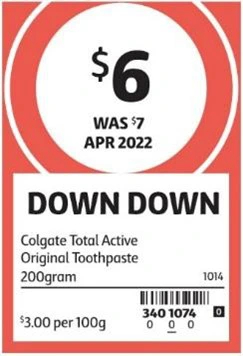
The Down Down program, introduced by Coles in 2010 and widely recognised through its memorable ‘Down Down, prices are down’ jingle performed by Status Quo, was a long-term promotional mechanism under which selected products were offered at discounted prices for a minimum of twelve weeks. A central feature of the promotion was the use of ‘was/now’ pricing on distinctive red and white tickets displayed on shelves and online, comparing the Down Down promotional price to an earlier higher price, for example:
The ACCC’s case focused on three prices:
- Price 1: the price at which the product had been regularly sold before any increase
- Price 2: the elevated “Was” price (the alleged “price spike”), often held for only a few weeks
- Price 3: the Down Down promotional price, which in 249 of the 255 instances was higher than Price 1
The ACCC’s primary case disregarded any changes in the wholesale (list) prices paid by Coles for the affected products, contending that the Down Down tickets did not refer to list prices and consumers were unaware of them.
Coles defended the proceedings by arguing that the price increases reflected genuine supplier cost price increases during a period of significant inflationary pressure, and that the ‘Was’ price stated on the tickets was a genuine undiscounted shelf price at or below the supplier’s recommended retail price. Coles contended that, on this basis, the subsequent Down Down price was a genuine discount from a genuine previous price.
The Court’s analysis
The trial was conducted with respect to 12 agreed sample products (involving 14 separate Down Down tickets), including Karicare Follow On Formula, Coca-Cola 2L, Pedigree Dog Food, Arnott’s Shapes Multipack, Bragg Nutritional Yeast, Danone Yopro Yoghurt, Colgate Total Toothpaste, Coles Finest Quince Paste, Rexona Deodorant, Lurpak Spreadable Butter, Nature’s Gift Dog Food, and Viva Paper Towels.
Justice O’Bryan adopted a four-step framework from similar cases, for assessing misleading or deceptive conduct, being:
- identifying the conduct;
- establishing it was in trade or commerce;
- determining what meaning the conduct conveyed; and
- assessing whether that meaning was misleading or deceptive or likely to mislead or deceive.
On the question of what meaning the “Down Down” notifications conveyed, the Court found that ordinary consumers shopping for groceries would not undertake an intellectualised process of analysis. Rather the consumer’s understanding of the “Down Down” notification would be “intuitive” and to the effect that any discount was genuine and not artificial, and that the identified previous price is “was an ordinary price that had been offered and sold by Coles for a reasonable period.”
The Court also drew upon Coles’ own internal ‘promotional guardrails’, which were business rules designed to prevent misleading conduct, as contemporaneous evidence of Coles’ understanding that a Down Down promotion conveys a genuine discount, and that a genuine discount requires the previous price to have been established for a sufficient period.
Indeed, until March 2022, Coles’ own guardrails required a minimum twelve-week price establishment period before a product could be placed on a new Down Down promotion following a cost price increase. However, in March 2022, Coles reduced this to four weeks in response to competitive pressure from Woolworths – a change the Court characterised as a ‘race to the bottom’ in compliance with the ACL.
The Court also considered the extensive line of ‘dual pricing’ authorities, drawing from these decisions the common thread that what constitutes a ‘reasonable period’ for a ‘was’ price is context-dependent and involves an evaluative judgment.
Findings
Having considered all relevant factors, including that the white ticket prices (the ‘was’ prices) had reasonable commercial bases reflecting genuine supplier cost increases, that products were sold in commercial volumes at those prices, and that Coles did not select artificially high prices, the Court nevertheless concluded that the critical factor was the duration for which the ‘Was’ prices were offered.
In the industry context of packaged grocery products with relatively stable prices, the Court held that a minimum period of twelve weeks was necessary for the ‘Was’ price to be considered established for a reasonable period. The sample products were typically offered at the ‘Was’ price for only approximately four weeks and sometimes less.
On this basis, the Court found that 13 of the 14 Down Down tickets examined were misleading, contravening both s 18(1) and s 29(1)(i) of the ACL. The sole exception was a Nature’s Gift Dog Food ticket which did not contain a ‘Was’ price and therefore could not convey a specific comparative discount representation.
Significance and implications
The decision is notable for several reasons. First, it confirms that ‘was/now’ pricing can be misleading even where the ‘was’ price has a genuine commercial basis and products are sold in commercial volumes at that price, if the duration of the higher price is insufficient in context. Second, the Court gave evidential weight to Coles’ own internal compliance policies as indicating an awareness that short establishment periods risk misleading consumers. Third, the Court acknowledged the competitive dynamics at play, noting that Coles relaxed its guardrails in response to Woolworths’ practices, but held that competitive pressure does not excuse non-compliance with consumer protection obligations.
The Court observed that its conclusion was “relatively narrow”: the tickets were misleading because products had not been offered at the ‘Was’ price for a reasonable period, and had Coles maintained the higher prices for twelve weeks, the tickets would not have been misleading. Interestingly, the Court acknowledged that this conclusion was notwithstanding that had Coles kept the price at the higher level for 12 weeks, arguably consumers would have been worse off.
In any event, and while it seems likely that the decision will be appealed, the case serves as an important reminder to retailers to ensure that any advertised discounts are genuine, and that expressly true statements may still be misleading in light of sufficient context.
The content of this article is intended to provide a general guide to the subject matter. Specialist advice should be sought about your specific circumstances.
[View Source]
