

Executive Summary
Traffic offences in Queensland are often assumed as being minor or regulatory. In practice, driving charges can carry a real risk of imprisonment, convictions being recorded, and other long term consequences.
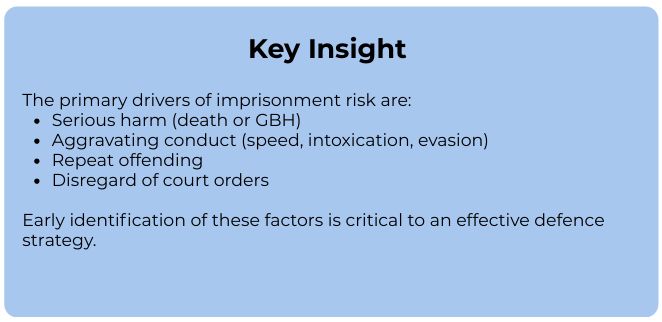
Risk increases depending on the facts, such as where there is injury, damage to property, prior offending, or a disregard of previous court orders.
Therefore, criminal defence lawyers in Queensland, should be aware of the risk to clients when facing serious driving charges including those risks which extend beyond the courtroom.
This can include real effects on employment, ability to look after family, and other consequences such as interlocks and mandated driving courses to be completed.
This paper sets out a practical framework for:
- Identifying high-risk matters early
- Structuring defence strategy
- Managing sentencing outcomes
- Achieving outcomes that reduce the risk of imprisonment
Why “Traffic Offences” Should Not be Assumed to be Minor
Whilst there are low-level driving matters which go before the court every day, it remains important for criminal lawyers to be alert to the potential risks to a client when reviewing a case.
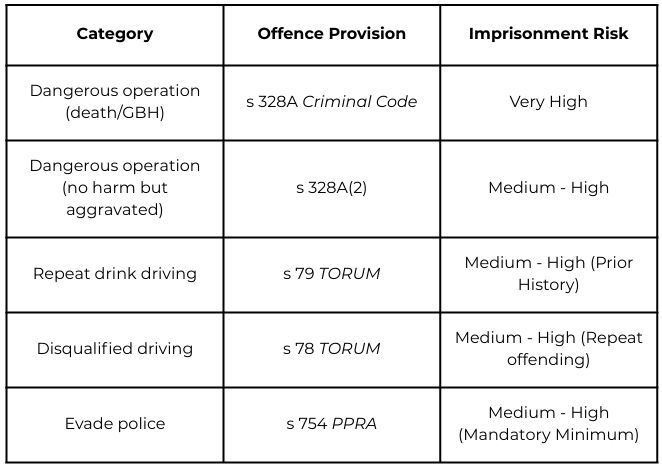
Some types of offences consistently carry a higher risk of custody.
Dangerous operation of a motor vehicle is at the top of that list, especially where there are aggravating features such as intoxication, excessive speed, racing, or leaving the scene.
High-range drink driving and repeat offending also increase risk significantly.
Driving whilst disqualified is treated seriously as it involves breaching a court order, and repeated offending in this category is often viewed as serious disregard for the law.
Evasion of police is another serious driving offence. It attracts mandatory penalties, including the possibility of actual imprisonment even for a first offence.
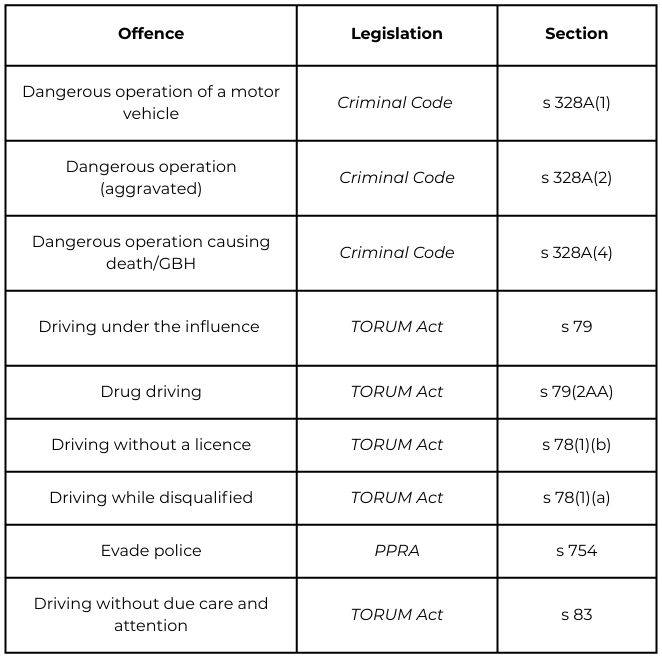
The key legislation governing these offences includes the Criminal Code 1899 (Qld), the Transport Operations (Road Use Management) Act 1995 (Qld) (‘TORUM’), and the Police Powers and Responsibilities Act 2000 (Qld).
Key Traffic Offences in Qld
Identifying Risk of Imprisonment
Dangerous Operation of a Motor Vehicle (s 328A)
Dangerous operation offences is one of the highest risk category of traffic-related criminal matters.
Penalties escalate significantly where:
- The offender is intoxicated
- Excessive speed is involved
- There is prior offending
- Death or grievous bodily harm is caused
Maximum penalties now reach 20 years imprisonment in aggravated cases.
Criminal Code 1899 (Qld) s 328A(6) - defines “dangerously” as “operate, or in any way interfere with the operation of, a vehicle dangerously” as operating a vehicle at a speed or in a way that is dangerous to the public, having regard to all the circumstances, including:
- the nature, condition and use of the place
- the nature and condition of the vehicle
- the number of persons, vehicles or other objects that are, or might reasonably be expected to be, in the place
- the concentration of alcohol in the operator’s blood or breath
- the presence of any other substance in the operator’s body’
Other important points:
- “Dangerously” takes its ordinary meaning and refers to driving that creates a real risk to others on the road (King v The Queen (2012) 245 CLR 588)
- The prosecution must show more than mere carelessness — the driving must objectively create a risk beyond that ordinarily associated with driving, including in cases involving fatigue (R v Jiminez (1992) 173 CLR 572)
- Dangerous driving requires a serious departure from proper driving standards, with the focus on the manner of driving rather than the outcome (McBride v The Queen (1966) 115 CLR 44)
Defence strategy in Dangerous Operation cases
Defending dangerous operation charges starts with an early and realistic assessment of risk. This includes looking closely at the client’s history, the level of danger involved, and any aggravating features such as speed, intoxication or a collision.
It is important to advise the client early about likely outcomes, disqualification periods, and whether it is better to resolve the matter quickly or delay while they make arrangements and complete rehabilitation steps.
A key part of the defence is breaking the charge down and testing whether the prosecution can actually prove each element. In particular, whether the driving was dangerous, rather than just careless or a momentary lapse. It is also important to check that the correct charge and any aggravating features have been properly applied, as this can significantly affect the outcome.
You should also consider whether any defences arise under the Criminal Code, such as an unwilled act (for example, falling asleep), mistake of fact, or extraordinary emergency. These can be highly fact-specific and, if available, can provide a complete answer to the charge.
Finally, always test the strength of the evidence and look for resolution opportunities. This includes challenging reliability, ensuring procedures have been followed, and considering expert evidence where needed. At the same time, explore whether the matter can be negotiated to a lesser charge or on a more favourable factual basis, particularly where aggravating features are in issue.
Sentencing - Dangerous Operation Charges
Sentencing for dangerous operation of a motor vehicle under s 328A of the Criminal Code 1899 (Qld) is primarily concerned with the objective seriousness of the driving. The courts have consistently emphasised that the focus is on the nature and quality of the driving itself, rather than the outcome alone.
In R v Jiminez (1992) 173 CLR 572 and McBride v The Queen (1966) 115 CLR 44, it was held that the conduct must involve a real and significant risk to the public, going beyond mere momentary inattention.
Where death or grievous bodily harm is caused, custodial sentences are commonly imposed, particularly in more serious cases.
In R v Morgan (1968) 52 Cr App R 235, it was established that imprisonment is essential in very serious cases. Aggravating features such as intoxication, excessive speed, prolonged dangerous driving, or leaving the scene significantly increase the penalty.
In R v Lightbody [2019] QCA 61, the Court of Appeal confirmed that the maximum penalty is an important yardstick and that leaving the scene is a serious aggravating feature attracting strong denunciation.
General deterrence remains a significant consideration. In R v Allen [2008] QCA 268 and as applied in R v Turner [2022] QCA 175, the courts emphasised that sentences must act as a reminder to the community of the serious responsibilities involved in driving, even in cases not involving alcohol or extreme speed.
However, sentencing is ultimately an individualised exercise. Factors such as youth, prior history, remorse and rehabilitation prospects may moderate the outcome. Comparative authorities such as R v Liu [2016] QCA 186, R v Huxtable [2014] QCA 249 and R v Muirhead [2019] QCA 244 demonstrate that sentences will vary depending on the level of culpability, but must balance personal mitigation against the need for deterrence and community protection.
Importantly, caution must be exercised when relying on comparative authorities due to significant increases in maximum penalties over time. Amendments in 2007 and more recently in 2024 have increased the maximum penalty for dangerous operation causing death or grievous bodily harm to 14 years, and up to 20 years in aggravated cases. Older authorities must therefore be read in light of the legislative framework at the time, and care should be taken to ensure that comparisons are made with cases decided under comparable maximum penalties.
Drink Driving (s 79 TORUM)
Sentencing for drink driving offences under s 79 of the Transport Operations (Road Use Management) Act 1995 (Qld) considers a range of factors including the level of intoxication, prior history, and the risk posed to the community.
The legislation creates a tiered framework based on blood alcohol concentration, with higher ranges attracting increasingly serious penalties, including imprisonment in more serious or repeat cases.
General and personal deterrence are dominant sentencing considerations in drink driving matters. Courts consistently emphasise the need to protect the community and discourage both the offender and others from engaging in similar conduct. This is especially so in cases involving high-range readings or repeat offending, where there is a clear pattern of disregard for the law.
While imprisonment is not inevitable, there is a real risk of custody in cases involving very high readings, poor traffic history, or where the offending is accompanied by dangerous driving or other aggravating features.
Disqualification is a central component of sentencing and often has significant practical consequences for offenders. The statutory framework prescribes mandatory disqualification periods, which increase based on prior offending within a five-year period, and the court retains a discretion to impose longer periods where appropriate.
The court will look at factors such as an early plea, lack of prior history, genuine remorse, and steps towards rehabilitation, including completion of driving programs or counselling.
Criminal lawyers should be familiar with the statutory framework, including ss 79 and 86 of the Transport Operations (Road Use Management) Act 1995 (Qld), together with the general sentencing principles in s 9 of the Penalties and Sentences Act 1992 (Qld).
Disqualified & Unlicensed Driving (s 78 TORUM)
Sentencing for disqualified and unlicensed driving under s 78 of the Transport Operations (Road Use Management) Act 1995 (Qld) largely depends on the client’s traffic history and the seriousness of the breach.
Offending while disqualified is treated more seriously than unlicensed driving because it involves breaching a court order, often viewed as a clear disregard for the law.
Deterrence is a key factor. Courts focus on preventing repeat offending and protecting the community, particularly where there is a pattern of disqualified driving.
While imprisonment is not automatic, there is a real risk of custody in cases involving repeat offending, recent disqualifications, or where the offence is committed alongside other offences.
Mandatory disqualification periods apply and can be significant, especially for repeat offenders. These periods often form an important part of the overall penalty and can have substantial practical consequences.
Practitioners should consider s 78 of the Act and the general sentencing principles in s 9 of the Penalties and Sentences Act 1992 (Qld).
Authorities such as Hastie v Commissioner of Police [2016] QDC 17 show that imprisonment is open but not inevitable, while Queensland Police Service v Cullen [2025] QDC 160 and Commissioner of Police v Robertson [2025] QDC 192 highlight the increasing likelihood of custody in cases of persistent offending.
Evade Police (s 754 PPRA)
Sentencing for evading police under s 754 of the Police Powers and Responsibilities Act 2000 (Qld) is treated as particularly serious due to the inherent risk to public safety and the deliberate nature of the conduct. The offence involves a failure to stop when directed by police and is often accompanied by dangerous driving, which elevates both the objective seriousness and the need for strong deterrence.
A key feature of this offence is the presence of mandatory minimum penalties, including either a fine or a period of actual imprisonment. Where imprisonment is imposed, the legislation requires a minimum period of custody to be served.
The offence also carries a mandatory driver licence disqualification of at least two years, regardless of the penalty imposed.
Deterrence and community protection are dominant considerations.
Courts recognise that failing to stop for police creates substantial risk not only to the driver but to other road users and police officers. As a result, sentences are often framed to send a clear message that such conduct will attract serious consequences, particularly where there are aggravating features such as speed, prolonged evasion, or prior offending.
Criminal lawyers should closely consider s 754 of the Act and the interaction with general sentencing principles under s 9 of the Penalties and Sentences Act 1992 (Qld). Authorities such as Doig v Commissioner of Police [2016] QDC 320 clarify that imprisonment is not inevitable in every case, while Commissioner of Police v Stjernqvist [2022] QDC 95 confirms that certain sentencing options, such as probation, are no longer available. These cases provide important guidance on the constrained sentencing framework and the significant role of deterrence in these matters.
Also consider R v Davis (2023) 14 QR 377, where the court highlighted that the interception of a vehicle by police must be for a ‘prescribed purpose’ under section 60 of the Police Powers and Responsibilities Act 2000.
Defence strategies
Early advice is critical so the client understands the likely outcomes, including the risk of imprisonment and lengthy disqualification, and can begin taking steps to mitigate that risk, such as engaging in rehabilitation or completing relevant driving programs.
A central focus is to carefully analyse the charge and whether the prosecution can prove each element beyond reasonable doubt. This involves breaking the offence down into its constituent parts and assessing whether there is admissible evidence to support each element.
Practitioners should also consider whether the correct section has been charged and whether any alleged aggravating features have been properly pleaded.
Consideration must also be given to available defences under Chapter 5 of the Criminal Code 1899 (Qld), including unwilled act, honest and reasonable mistake of fact, and extraordinary emergency.
These defences can be particularly relevant in driving cases involving fatigue, confusion, or urgent circumstances. Cases such as R v Jiminez (1992) 173 CLR 572 and Savage v ESC [2025] QMC 19 demonstrate how these defences may arise in practice and, in appropriate cases, result in acquittal.
Finally, criminal defence lawyers should consider whether the evidence has been lawfully obtained and whether there is scope to negotiate a lesser charge or agreed facts. This may include resolving a disqualified driving charge to unlicensed driving or removing an aggravating feature. It is also important to review whether the prosecution has complied with procedural requirements, such as issuing a notice under s 47 of the Justices Act 1886 (Qld) where prior convictions are relied upon to increase the penalty.
These strategic considerations can significantly impact both the outcome and the ultimate sentence.
Conclusion
Serious traffic offences in Queensland carry significant consequences, including imprisonment and lengthy disqualification periods, and should not be treated as minor or routine matters.
The legislative framework, particularly under TORUM, the Criminal Code, and the Police Powers and Responsibilities Act, is complex and requires careful navigation.
Outcomes are highly fact-specific and turn on the objective seriousness of the conduct, the presence of aggravating features, and the client’s history.
From a defence perspective, early preparation and strategic decision making are critical. A careful analysis of the charge, the available evidence, potential defences, and procedural compliance can materially affect the outcome.
Where appropriate, negotiation, rehabilitation steps, and well-prepared sentence submissions can reduce risk to the client.
Ultimately, these matters require a structured and proactive approach to ensure the best possible result in circumstances where there are potentially serious consequences to a client.
The content of this article is intended to provide a general guide to the subject matter. Specialist advice should be sought about your specific circumstances.
[View Source]