

The Occupational Health and Safety (Psychological Health) Regulations 2025 (Regulations) commenced in Victoria late last year, imposing new and more prescriptive obligations on employers to manage psychosocial hazards. For many organisations, this will require a shift away from policy-led approaches towards more proactive changes to how work is designed, managed and performed.
Similar to the framework that has long applied to physical hazards, the Regulations require employers to identify, assess, control and review risks to psychological health. The changes align Victoria with other Australian jurisdictions and reflect a broader regulatory and governance expectation that psychological health is a core component of workplace safety.
Given the enforcement powers available to WorkSafe Victoria, and the link between compliance with these obligations and successful workers' compensation claims, employers that do not adapt their approach confront increased regulatory and litigation risk.
What are psychosocial hazards?
Psychosocial hazards are broadly defined as factors arising from the work environment, work design or management of work that may cause an employee to experience a negative psychological response, creating a risk to their health and safety.
Common examples include:
- bullying and harassment
- exposure to aggression or violence
- excessive or unreasonable job demands
- low role clarity
- poor organisational change management
- inadequate supervision or support.
Reliance on HR policies no longer sufficient
Traditionally, many employers have approached psychosocial risks through human resources frameworks, relying primarily on policies, codes of conduct and training programs to influence individual behaviour. The Regulations make clear that this approach is no longer sufficient.
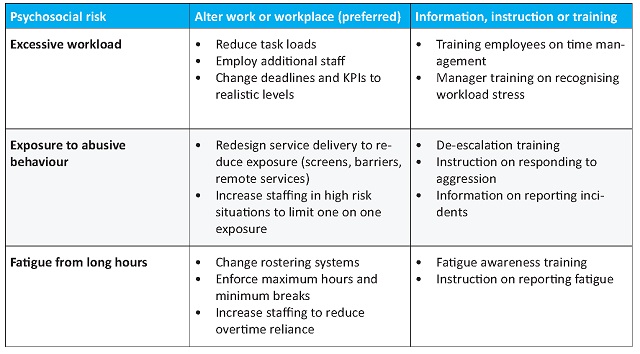
Employers are required to prioritise controls that alter the work or workplace itself, such as work design, systems of work, management practices or the working environment. Information, instruction and training may only be relied upon where these higher-order controls are not reasonably practicable and must not be the predominant measure where other controls are available.
The distinction is illustrated below:
Likely areas of regulatory focus and broader implications
In light of the new Regulations, WorkSafe Victoria is expected to increase its focus on how employers are identifying and managing psychosocial hazards during audits, inspections and investigations. This may include scrutiny of:
- how psychosocial hazards are identified, particularly those arising from work design and systems
- the nature and effectiveness of control measures
- how concerns, incidents and complaints are handled and addressed
- whether controls are being reviewed following incidents, requests or organisational changes.
Practical steps for employers
Compliance can no longer be demonstrated by having policies in place or delivering training. Employers must be able to demonstrate active, ongoing management of psychosocial risks.
Employers should take the following steps to ensure compliance:
- assign clear senior-level responsibility for psychosocial risk management
- systematically identify hazards arising from work design, workloads, job demands, change processes and management practices, using consultation, surveys, incident data, complaints, absenteeism and turnover trends
- genuinely consult with employees and health and safety representatives throughout hazard identification, risk assessment, control selection and review
- implement effective control measures that address root causes
- ensure clear reporting pathways and timely responses to psychosocial hazards and incidents
- regularly review controls, particularly after incidents, upon request or prior to organisational change
- maintain appropriate records to demonstrate compliance and audit readiness.
If you have any questions regarding how to identify and manage psychosocial hazards in your workplace, please contact us here.
This publication does not deal with every important topic or change in law and is not intended to be relied upon as a substitute for legal or other advice that may be relevant to the reader's specific circumstances. If you have found this publication of interest and would like to know more or wish to obtain legal advice relevant to your circumstances please contact one of the named individuals listed.

