

- with readers working within the Environment & Waste Management industries
- within Consumer Protection and Real Estate and Construction topic(s)
Welcome to a Special Edition of P2N0.
This Special Edition covers the UN General Assembly’s decision to adopt a resolution endorsing the Advisory Opinion of the International Court of Justice on the obligations of countries in respect of climate change.
SUMMARY OF THE UNGA RESOLUTION
Headline: On May 20, 2026, the United Nations General Assembly (UNGA) adopted a resolution on the “Advisory Opinion of the International Court of Justice on the Obligations of States in Respect of Climate Change”.
While the Advisory Opinion of the International Court of Justice (ICJ) and the resolution of the UNGA are commended in the context of action to address climate change, neither the Advisory Opinion nor the UNGA Resolution change international law as it relates to climate change.
This Special Edition of P2N0 provides background to the Advisory Opinion of the ICJ, and, among other things, it provides a summary of the duties and obligations of countries to address climate change.
From a personal perspective, the author is as concerned about climate change and environmental degradation as the next person. While the Advisory Opinion of the ICJ is to be welcomed, it should be regarded as a call to action for increased mitigation of climate change by all countries, not a call to legal action against any country.
Background: The ICJ has two roles:
- to settle, in accordance with international law, legal disputes submitted to it by Member States of the UN (primary role); and
- to give advisory opinions on legal questions referred to the ICJ by UN agencies and bodies.
On March 29, 2023, the UNGA (by resolution 77/276) asked the ICJ to answer two questions:
Question 1: “What are the obligations of States under international law to ensure the protection of the climate system and other parts of the environment from anthropogenic emissions of greenhouse gases for States and for present and future generations?”1; and
Question 2: What are the legal consequences under these obligations for States where they, by their acts and omissions2 , have caused significant harm to the climate system and other parts of the environment, with respect to:
- States, including, in particular, small island developing States where they, by their geographical circumstances and level of development, are injured or specifically affected by or are particularly vulnerable to the adverse effects of climate change?
- Peoples and individuals of the present and future generations affected by the adverse effects of climate change.
• The Advisory Opinion was issued by the ICJ on July 23, 2025.
As reported, 141 countries voted for the adoption of the resolution, 8 voted against, and 28 abstained. It does not matter who voted for and against, and who abstained. What matters is the need for a clear understanding of the nature of the duties and obligations of countries to address climate change. Neither the Advisory Opinion nor the UNGA add to the duties and obligations of any country.
Reporting on expectation over fact: Some of the reporting of the Advisory Opinion and the UNGA may be regarded as reporting what are hoped to be the duties and obligations of countries, rather than in law the nature and extent of the duties and obligations of countries.
Some reporting on the UNGA Resolution states that Advisory Opinions of the ICJ have “significant legal and moral authority” and help to clarify international law in respect of the legal duties and obligations. Some reporting expresses the view that Advisory Opinions of the ICJ develop the legal duties and obligations of countries.
In a strict sense, reporting of this kind is not accurate: the ICJ provides answers to legal questions put to it by the UNGA, based on assumed facts, not on actual facts in dispute (as in the case of the ICJ in its primary role). As a result, the ICJ may seek to answer questions as fully as possible and in so doing state the maximum possible extent of duties and obligations of countries. In short, in preparing the Advisory Opinion the ICJ did what was asked of it by the UNGA by Resolution 77/276.
Reporting fully: In addition to publishing pieces on the scope of the Advisory Opinion, the Baker Botts Singapore team has presented widely on the Advisory Opinion.
The key point to note is that any Advisory Opinion of the ICJ is advisory only, no advisory opinion is binding.
In asking the ICJ to provide an Advisory Opinion to answer the two questions posed by Resolution 77/276, the UNGA asked the ICJ to outline to the fullest extent possible the duties and obligations of countries. The Advisory Opinion does this.
While the Advisory Opinion outlines the maximum possible extent of the duties and obligations of countries, the Advisory Opinion leaves open and unanswered key issues, including (fundamental legal principles):
- While the basis of responsibility for an Internationally Wrongful Act is well-established and is clear, what is not clear is the basis upon which any country may be liable for an Internationally Wrongful Act in the context of climate change.
- The reason for this lack of clarity is that for any action to be successful in respect of any Internationally Wrongful Act (if such Act is proved), it will be necessary:
- to attribute loss and damage to the Internationally Wrongful Act; and
- to prove the causal connection to the Internationally Wrongful Act and the loss or damage caused.
In any case brought against any country in the ICJ (in its primary role), facts would be in dispute, and the fundamental legal principles would have to be applied to prove causation and damage.
While the Advisory Opinion recognizes the challenges of attribution and causation, it does not seek to solve for them. The good thing is that these challenges are recognized. The challenges are fundamental.
Lawyers reading this Special Edition of P2N0 will recognise the fundamental legal principles as likely to preclude any action being successful. For the non-lawyers none of the reporting on the Advisory Opinion or the UNGA (at least the reporting that the author has read) covers the fundamental legal principles.
The table below summarizes the duties and obligations of countries (as assessed by the author) from the Advisory Opinion, as distinct from the outline in the UNGA Resolution.
|
Duties and Obligations of States – The High-Water Mark |
|||||
|
Climate Change Treaties, other than UNCLOS |
UNFCCC:
|
Kyoto Protocol: States that are Party to the Kyoto Protocol were required to comply with the provisions of it. (The Kyoto Protocol is relevant now in the context of interpretation only.) |
Paris Agreement:
|
||
|
|
||||
|
UNCLOS |
States that are Party to UNCLOS to ensure the protection of the climate system and other parts of the environment from anthropogenic greenhouse gas emissions, including from the adverse effects of climate change and to cooperate in good faith. |
||||
|
Environmental Treaties |
Ozone Layer Convention & Montreal Protocol |
Biodiversity Convention |
Desertification Convention |
||
|
Each State that is party to an Environmental Treaty has an obligation to ensure the protection of the climate system and other parts to the environment from anthropogenic greenhouse gas emissions6. |
|||||
|
International Customary Law |
jurisdiction or control from causing significant harm to the climate system and other parts of |
||||
|
the environment, in accordance with common but differentiated responsibilities and respective capabilities7; and
|
|||||
|
International Human Rights Law |
States have duties to ensure the effective enjoyment of human rights by protecting the climate system and other parts of the environment. |
||||
|
Other principles |
Sustainable Development |
Common, different, responsibilities and capacities |
Equity & Intergenerational Equity |
Precautionary Approach / Principle |
Polluter Pays principle |
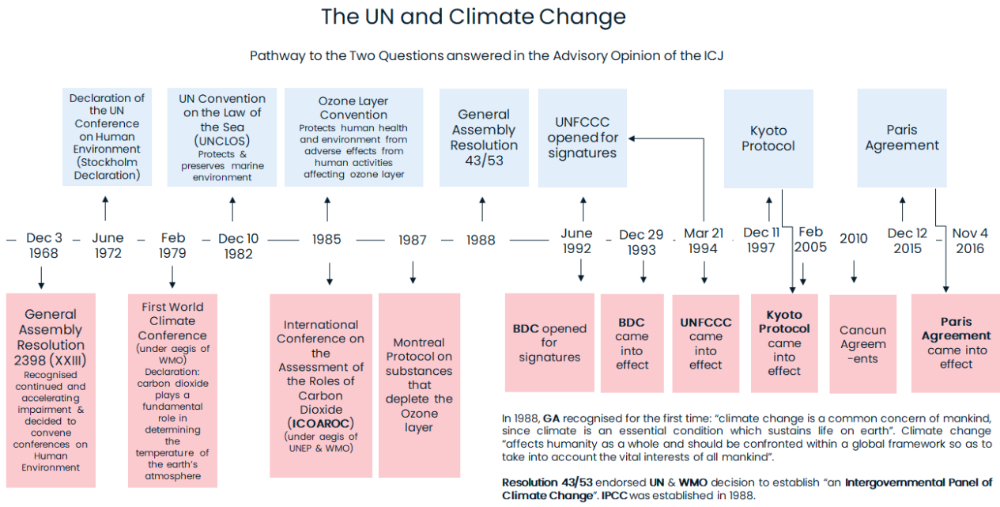
By way of background, the UN has been instrumental in the recognition of climate change and seeking to address it. The timeline at the end of this Special Edition of P2N0 illustrates the instrumental role that the UN has played. The role of the UN is informed by the UN Charter which defines its role in respect of matters that are “common concerns of mankind”.
The timeline at the end of this Special Edition of P2N0 outlines the role of the UN, including in respect of each of the Climate Change and Environmental Conventions referred to in the table above.
Conclusion: The UNGA Resolution outlines some conclusions of the ICJ in the Advisory Opinion. The outline in UNGA Resolution is correct in noting that breach by a country may constitute an Internationally Wrongful Act. This is not new. What is important to understand, however, is that proceeding successfully against any country for an Internationally Wrongful Act is going to be difficult, at best. The focus should not be on bringing actions for Internationally Wrongful Acts (which will not address climate change), rather the focus should be on addressing climate change.
The UNGA Resolution recognizes the need to address climate change, calling for the translation of the Advisory Opinion:
“… into enhanced multilateral cooperation and accelerate climate action in all levels, consistent with international law”.
The call for enhanced cooperation recognizes that the achievement of objectives on climate change are defined by reference to action by all countries. The objectives of the Paris Agreement will be achieved by the actions of all countries in combination. They will not be achieved by legal action against countries.
This is a call for action under existing Climate Change and Environmental Conventions and international law. It is not a call to action on the basis of anything new from a legal perspective. It is important that this reality is not conflated with unclear statements as to the nature and extent of countries.
In this context, a cautionary note is sounded: countries have the ability to withdraw from Conventions. Withdrawal is not good. The withdrawal of the US from the Paris Agreement makes it considerably less likely that the objectives of the Paris Agreement will be achieved. This is the case no matter what the level of cooperation exists among the remaining parties to the Paris Agreement.
Given the withdrawal of the US from the Paris Agreement it is not surprising that the US voted against the UNGA Resolution9, being a resolution under the aegis of the UN General Assembly (not the Conference of Parties for the purposes of the Paris Agreement). In passing, it is noted that India, Nigeria, Qatar and Türkiye abstained, each is important currently, and each will have increased importance over time.
In addition to enhanced multilateral cooperation, enhanced understanding of the position of each party to the Paris Agreement is required. Further, withdrawals will undermine the achievement of the objectives of the Paris Agreement.
Footnotes
1 Note: Expressly limited as relating to existing obligations and relating to climate change and environment.
2 Note: Not a wrongful act of omission, rather any act or omission.
3 Annex I lists Australia, Austria, Belarus, Belgium, Bulgaria, Canada, Croatia, [Czechia], Denmark, [EU], Estonia, Finland, France, Germany, Greece, Hungary, Iceland, Ireland, Italy, Japan, Latvia, Liechtenstein, Luxembourg, Monaco, Netherlands, New Zealand, Norway, Portugal, Romania, Russian Federation, Slovakia, Spain, Sweden, Switzerland, Turkey, United Kingdom and United States of America.
4 With all NDCs taken together capable of achieving the temperature goal of limiting global warming to 2OC / 1.5OC above pre- industrial levels. Note: This is impossible in concept and is wrong by reference to Article 2 of the Paris Agreement.
5 In the context of the objectives of, and the means to address climate change under the Paris Agreement, it is important to understand that the Paris Agreement does not impose any obligation on any country to achieve a specific avoidance, reduction or removal of GHG emissions outcome, it imposes obligations as to process. The achievement of the objectives of the Paris Agreement is reliant entirely on cooperation of the contracting parties to it.
6 This may be regarded as something of “a stretch” given the terms of the Environmental Treaties and must be read strictly to the Treaty.
7 This duty / obligation is not distinct to a country in a clear sense, rather it is defined by reference to other countries.
8 This duty / obligation is not distinct to a country in a clear sense, rather it is defined by the need for cooperation.
9 While not germane to this Special Edition of P2N0, Iran, Israel, Kingdom of Saudi Arabia, Liberia, Russia, Belarus, and Yemen also voted against.
The content of this article is intended to provide a general guide to the subject matter. Specialist advice should be sought about your specific circumstances.
[View Source]