

Tariffs and political tumult didn't do as much harm as some expected and 2026 could provide some needed stability
Global M&A Outlook 2026 – Regional perspectives
It's fair to say 2025 did not live up to its promise of an M&A recovery; but it also did not tank to the depths some expected following domestic political turmoil and ongoing trade tensions caused by tariffs and geopolitics.
Less is better
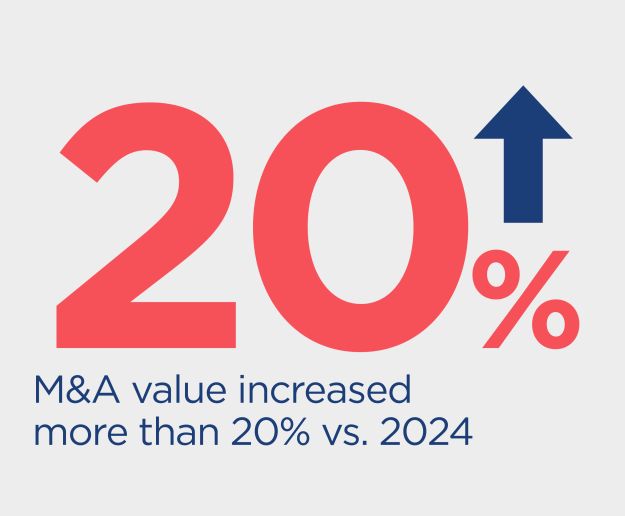
M&A in France increased in value over 20% compared to last year, and increased in volume by around 10%, reflecting bigger ticket sizes rather than overall activity. This concentration reflects investor caution in an unstable and unwelcoming environment, and a flight to quality with investors seeking trophy assets rather than multiplying smaller transactions.
The year also saw a deepening trend of longer deals with cautious buyers and sellers willing to hold assets to increase competition or pause processes awaiting better conditions. In parallel, deals have become more legally sophisticated, with negotiations growing lengthier and more complex. This evolution reflects the impact of intensified regulatory scrutiny, reshaping the market into one where caution, compliance, and strategic foresight are now central to deal-making.
This evolution reflects the impact of intensified regulatory scrutiny, reshaping the market into one where caution, compliance, and strategic foresight are now central to deal-making.
French corporates go hunting abroad
Perhaps searching to mitigate their exposure to France in an uncertain local climate, large French corporates were particularly active abroad in 2025, embracing international expansion by giving birth to some of the most notable deals of the year, proving that strategic transactions are not fatally impacted by domestic issues.
Banijay, a French entertainment and gaming group acquired Germany's sports betting group Tipico for €4.8 billion, while BPCE acquired Portugal's Novo Banco for €6.4 billion, making it one of Europe's largest cross-border banking deals in a decade. Orange strengthened its international footprint by taking full control of its Spanish joint venture. Meanwhile, in aerospace, Thales, Airbus, and Leonardo signed a memorandum of understanding to merge their space divisions in a €6 billion deal, a move poised to create a European, if not global, champion.
The fact that the market price of many corporates involved in these transactions ticked up after the announcements showed investor appetite for substantial transactions (as well as perhaps a certain fatigue with the status quo). This reaction could encourage more corporates to follow a similarly bold strategy.
Sectors
Technology remained a key driver of M&A activity, with AI, cybersecurity, and cloud computing attracting significant interest, from both tech investors and industrial players looking to accelerate their digital transformation strategy.
A notable illustration is the €1.7 billion funding raised by French startup Mistral AI, led by ASML, underscoring both the strategic importance of AI capacity and France's growing role in Europe's AI landscape.
Data centres also continued to be considered prime assets bridging the technology sector and infrastructure sector, both very healthy sectors for deals in 2025. Data centres can be expected to continue to be popular assets into 2026 (with the expected auction of Evernex as a prime example).
Healthcare and life sciences remain robust, with strong interest in pharmaceuticals, biotechnology, and medtech. French companies are both targets and acquirers in this globalised sector, with partnerships and consolidations designed to boost research, development and market reach.
Sanofi led the way by strengthening its specialty care and vaccine portfolio with major acquisitions, including the US$9.1 billion purchase of Blueprint Medicines (which specialises in treatments for rare immunological diseases), Dynavax Technologies for US$2.2 billion (securing the only two-dose hepatitis B vaccine), and a Dren Bio subsidiary for US$1.9 billion (adding a first-class antibody program targeting autoimmune diseases).
Energy also continued to be a healthy sector, with notably Ardian's €2.3 billion acquisition of Akuo Energy from Intermediate Capital Group.
Distressed activity
In 2025, France's largest distressed M&A deals included Atos selling its advanced computing assets to the French state for about €410 million, Technicolor Group's court-driven carve-outs of major animation and VFX units to buyers like Rodeo FX and TransPerfect, and Casino continuing its restructuring with creditor-backed capital measures.
Deals in the wings
2025 was also about deals that didn't happen.
The €17 billion offer for Altice's telecom unit SFR from its three competitors Orange, Bouygues and Iliad was rejected, but observers expect renewed attempts or restructuring-driven solutions.
Similarly, TDF, the French telecoms infrastructure provider, is expected to return to the market after the sellers suspended the sale process due to disappointing valuation.
Outlook for 2026
The outlook for the French M&A market in 2026 points to cautious stabilisation after several years of volatility. Although political and economic uncertainty persists, dealmakers appear increasingly prepared to navigate this environment. Drivers that maintained 2025 at acceptable levels such as continued digitalisation, improving financing conditions, maturing energy transition markets and assets, growing market resilience to political aloofness, and, more recently, emerging factors like increased defence spending, increasingly mature turnaround opportunities, and an already visible backlog of delayed deals expected to land on the market, could make 2026 the rebound year that 2025 failed to be.
The content of this article is intended to provide a general guide to the subject matter. Specialist advice should be sought about your specific circumstances.
