

- with Finance and Tax Executives and Inhouse Counsel
- with readers working within the Law Firm industries
- in European Union
General Updates
India – European Union Free Trade Agreement ("FTA") signed
With the aim to foster trade, investment, innovation and job creation in India and European Union, FTA negotiations between the two countries have concluded and FTA signed. This will deepen economic integration along with trade liberalisation and tariff concessions.
India – United States of America Trade Agreement
Both the nations i.e. India and United States of America are in talks regarding their trade agreement - details of which are awaited.
Union Budget for financial year 2026-2027 presented
The Ministry of Finance has presented the Budget and key highlights of the same include scaling up of 7 (seven) manufacturing sectors with various schemes; dedicated funds for Micro, Small & Medium Enterprises; setting up of Infrastructure Risk Guarantee Fund; environment friendly movement of cargo; establishment of Education to Employment and Enterprise' Standing Committee; promotion of medical tourism services; launch of Bharat-VISTAAR (Virtually Integrated System to Access Agricultural Resources); focus on mental health and trauma care; changes in Income Tax Act, Rules and Forms; exemption of interest awarded by Motor Accident Claims Tribunal; revisions in timelines for filing tax returns; Khelo India Mission; changes in safe harbour provisions rules amongst many.
Draft Pesticides Management Bill, 2025 released
In an effort to update the Insecticides Act, 1968, the Ministry of Agriculture & Farmers Welfare has released the Draft Pesticides Management Bill, 2025 for public comments. Having focus on human health, environmental safety and farmer welfare, the proposed legislation aims to modernize pesticide regulation by addressing the full lifespan of pesticides, from manufacturing and import, to sale, usage and disposal. It introduces risk-based approvals, stronger surveillance, digital governance and mandatory accreditation of testing laboratories to ensure quality products reach farmers and curb spurious or substandard pesticides. The draft further includes provisions to decriminalize minor violations with risk-appropriate penalties, aiming to strike a balance between the ease of living for farmers with the ease of doing business for stakeholders. It further establishes a Central Pesticides Board and a Registration Committee.
Foreign Exchange Management (Export and Import of Goods and Services) Regulations, 2026 notified
The Reserve Bank of India has notified the Foreign Exchange Management (Export and Import of Goods and Services) Regulations, 2026, which will come into force from 1 October 2026. These regulations comprehensively lay down the framework governing export and import transactions, including declaration requirements, modes of receipt and payment, timelines for realisation of export proceeds and import payments. Under the new regime, export proceeds for goods (other than warehouse exports) and services must generally be realised and repatriated within 15 (fifteen) months from the date of shipment or invoice, respectively, while goods exported to overseas warehouses must be realised within 15 (fifteen) months from the date of sale. Project exports will follow contract-specific payment terms. The regulations also empower Authorised Dealers to permit reduction or non-realisation of export value based on exporter justification, with a simplified declaration-based approach. Overall, the regulations aim to streamline procedures while strengthening monitoring and compliance under Foreign Exchange Management Act, 1999.
Securities and Exchange Board of India (Mutual Funds) Regulations, 2026 ("2026 Regulations") notified to Modernise Mutual Fund Framework
The Securities and Exchange Board of India has notified the 2026 Regulations, which will come into force from 1 April 2026. These regulations replace the earlier 1996 framework and provides a consolidated, modernised regime governing registration, eligibility, governance, trusteeship, asset management companies, mutual fund schemes, disclosures and regulatory oversight. Overall, the 2026 Regulations represent a decisive move towards improved governance, cost transparency and enhanced accountability in the mutual fund industry.
Virtual Private Networks ("VPNs") to block sites leaking Indian citizens' data
The Ministry of Electronics and Information Technology has issued a stern advisory directing VPN providers and other online intermediaries to immediately block websites compromising the personal data of Indian citizens, signalling a robust push to safeguard digital privacy and combatting identity theft and financial fraud. The directive reinforces India's evolving data-accountability framework and marks a decisive shift in assigning greater legal responsibility to intermediaries amid a surge of high-profile data breaches impacting millions.
Corporate Law Updates
Amendment in the Companies (Appointment and Qualification of Directors) Rules, 2014
The Ministry of Corporate Affairs ("MCA") vide its notification has introduced the Companies (Appointment and Qualification of Directors) Amendment Rules, 2025 which will come into force on 31 March 2026. As per the said amendment, the annual Know Your Customer ("KYC") requirement have been replaced with simpler KYC intimation once in every 3 (three) years. An individual who holds a Director Identification Number as on 31 March of the financial year, shall file form DIR-3 KYC Web on or before the 30 June of the immediately following every 3 (third) consecutive financial year. Any change in particulars such as personal mobile number, email address or residential address, shall be reported within 30 (thirty) days of such change.
Amendment in the Companies (Removal of Names of Companies from the Register of Companies) Rules, 2016
As per recent notification, the MCA has mandated that in case of a government company (including its subsidiaries) indemnity bond in Form STK-3A, in respect of directors appointed or nominated by the government, shall be given by an authorised representative not below the rank of Under Secretary or equivalent, in the administrative Ministry or Department of the Government of India or the State Government, as the case may be, on behalf of the Company
Extension of applicability of MCA notification pertaining to establishment of Registrars of Companies
The MCA has extended the effective date of its notification dated 24 October 2025 from 1 January 2026 to 16 February 2026. The said notification pertains to the establishment of Registrars of Companies with specific territorial jurisdictions under the Companies Act, 2013.
Launch of revised Forms for the Liquidation Process
The Insolvency and Bankruptcy Board of India ("IBBI") vide its notification has amended the IBBI (Liquidation Process) Regulations, 2016 which mandates the Insolvency Professionals to file revised Forms, along with enclosures thereto, as notified by the IBBI, from time to time, on an electronic platform of the IBBI as per the timelines stipulated for each form.
Labour Law Updates
Delhi Shops and Establishment (Amendment) Bill 2026 ("Bill 2026") passed
The Delhi Government has passed the Bill 2026. Salient features of the same include applicability on shops and establishment with 20 (Twenty) or more employees; increase in daily working hours from 9 (nine) to 10 (ten), inclusive of rest and lunch break; break after 6 (six) hours; period of work shall not be more than 12 (twelve) hours; applicability of POSH Act; written consent of women employee for night shift including having minimum of 2 (two) women employee during the shift; proper light and CCTV camera; rest rooms; transportation facilities; amongst others.
Draft Rules under Labour Codes Issued
The Ministry of Labour and Employment has released draft Rules under all four Labour Codes, namely the Code on Wages, Code on Social Security, Industrial Relations Code and Occupational Safety, Health and Working Conditions Code for public comments, marking a significant step towards operationalising India's reformed labour law framework. The draft Rules seek to replace and consolidate provisions spread across 29 (twenty-nine) central labour laws into a simplified, technology-driven compliance regime. Key proposals include electronic registration, licensing and filing of returns, streamlined procedures for dispute resolution, recognition of trade unions, formation of works and safety committees and clearer processes for strikes, lockouts, retrenchment and closure. The draft Rules also elaborate employer and employee obligations relating to workplace safety, health standards, working hours, contract labour and migrant workers. Under the social security framework, the Rules provide for digital enrolment, administration of social security funds, maternity benefits, gratuity and governance of social security boards. The wagerelated Rules detail definitions of wages, fixation of minimum and floor wages, timelines and modes of wage payment, permissible deductions, maintenance of registers and appeal mechanisms.
Malayalam Language Bill, 2025 passed
The Kerala Assembly has passed the Malayalam Language Bill, 2025 which declares Malayalam as the official language of the State. It mandates all bills and ordinances, judgement and court proceedings in Malayalam language. It further renames Department of Personnel and Administrative Reforms (Official Language) to Malayalam Language Development Department.
Components of Compensatory allowance clarified
The issue before Supreme Court of India was whether compensatory allowances, such as House Rent; Transport; Clothing and Washing; and Small Family Allowances would fall within the ambit of term "ordinary rate of wages" for calculation of overtime wages as per relevant provisions of the Factories Act, 1948. The Apex Court opined that the "ordinary rate of wages" includes basic wages and "such allowances" as the worker for the time being is entitled to. The Act provides for only two specific exclusions – "bonus" and "wages" for overtime work.
Intellectual Property Updates
Landmark Sound Mark Registration for Taj Hotels – A New Frontier in Brand Protection
Taj Hotels has achieved a notable milestone under the Indian Trade Mark law by securing registration for its distinctive sound mark, extending brand protection beyond traditional logos and word marks. The registration covers use across hospitality services as well as digital platforms, recognising the brand's unique audio signature as a legitimate source identifier. The Taj sonic mark, which is made up of particular musical notes organised in a precise pace and key, is now officially acknowledged under the Trade Marks Act. The move also signals the growing acceptance of non-traditional trademarks in India. By protecting its sonic identity, Taj has not only strengthened its intellectual property portfolio but also set an important precedent for other service-oriented brands to explore and safeguard innovative branding assets that go beyond the visual.
"Shaadi.com" declared Well-Known Mark
The Bombay High Court has declared "shaadi.com" to be a Well-Known Mark. The Defendants were using "getshaadi.com". The Court analysed the evidence and held that that Defendant were using the mark and domain name "getshaadi.com" in relation to services identical to those offered by the Plaintiff, namely matrimonial and matchmaking services. A comparison of the rival marks and services also leaves no room for doubt that the marks "Shaadi.com" and "getshaadi.com" were found to be deceptively similar. The Court also awarded costs of Rs. 25 (twenty-five) Lakhs (US$ 28,000 approximately) to the Plaintiff.
Employment Agreement is acceptable 'Proof of Right' in Patent Filings
The Delhi High Court ("DHC") has overturned the controller decision which held that an employment agreement could not substitute a formal assignment deed. The Court ruled that procedural requirements should not defeat substantive rights and accepted the employment agreement and accompanying declarations as valid proof of right. It emphasized that such documents, when properly executed, fulfil the statutory mandate under relevant provisions of the Patent Act, 1970.
"SOCIAL" - a Well-Known Mark
The DHC has declared "SOCIAL" as a well-known trademark under relevant provisions of the Trade Marks Act, 1999. Recognising the Plaintiff's extensive nationwide operations, substantial turnover, significant promotion and long-standing goodwill since 2014, the Court restrained the Defendant from using the mark "THE SHAKE SOCIAL" for identical services i.e. restaurant and café services – holding that the adoption was dishonest and amounted to trademark infringement, passing off and dilution. The judgment sets a highwater mark for hospitality brands — demonstrating that sustained use, nationwide recognition, financial metrics and enforcement can elevate a brand to well-known status, unlocking enhanced anti-dilution protection across India.
Hospitality businesses must obtain licenses before playing copy righted music; liability is strict and cannot be avoided by claiming ignorance
The DHC has restrained the Defendants, operators of pubs and bars, from publicly playing copyrighted sound recordings without licenses from Phonographic Performance Ltd., holding that hospitality businesses are strictly liable for copyright compliance and that ignorance or lack of intent is no defence when exploiting works for commercial gain.
Patent Cooperation Treaty ("PCT") Open House for stakeholders announced
The Office of the Controller General of Patents, Designs and Trade Marks ("Office") have issued a public notice inviting innovators, applicants and Intellectual Property professionals to participate in its initiative of quarterly PCT Open House sessions for 2026. The initiative aims to provide guidance, clarify procedures and address queries related to international patent filings under the PCT system.
Cautionary Notice published regarding misleading and illegal advertisements
A cautionary notice has recently been issued by the Office regarding the increasing number of online service providers and/or websites doing misleading and illegal advertisements to solicit trademark work.
These websites are (i) claiming that anyone can secure a trademark registration through their online portal; (ii) charging fees lesser than government official fees; and (iii) contacting applicants/agents/ attorneys telephonically to enquire about the status of trademark applications and offering their services.
A list of totals 18 (eighteen) such websites (mentioned in table below) is published by the Offices to caution the public at larger against such fraud:
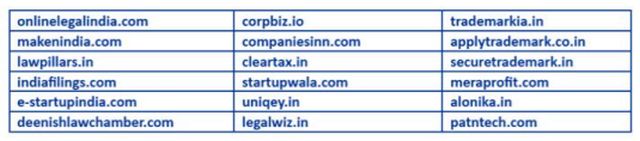
The issued notice is with goal of the Office to have transparent, secure and fair Intellectual Property registration system.
Concept Note released for proposed amendments to the Design Act, 2000
The Ministry of Commerce & Industry has released a concept note which outlines proposed amendments in the Design Act, 2000 for public comments. The objective of these amendments is to modernise the India's design protection framework and align the same with international practices. The highlights of the Concept Note include revisions in definition of 'article' and 'design'; grace period of 12 (twelve) months; provision of deferring publication of design for upto 30 (thirty) months; statutory damages; revision in term of protection of design; provision of filing multiple designs in a single design application; division of application; amongst others.
Case Laws
Lawyers cannot be compelled to disclose source of documents
The DHC has held that Courts cannot compel a lawyer to disclose the source of the documents and all consequential proceedings documents. They are protected by the Client-Advocate privilege under relevant provisions of the erstwhile Indian Evidence Act, 1872.
The content of this article is intended to provide a general guide to the subject matter. Specialist advice should be sought about your specific circumstances.
[View Source]
