

The globalization of the digital economy has made the international movement of data standard operating procedure for modern businesses. Whether utilizing cloud storage architectures hosted in North America, sharing customer profiles with a European parent entity, or outsourcing software analytics to Southeast Asia, Nigerian subsidiaries and multinational corporations face complex regulatory demands.
In Nigeria, outbound data flows are strictly regulated. With the full implementation of the Nigeria Data Protection Act (NDPA) and the operational directives under the General Application and Implementation Directive (GAID) in force, cross-border data transfer is prohibited by default unless specific statutory exceptions or compliance mechanisms are firmly established.
Failing to secure these international pipelines risks severe exposure: the Nigeria Data Protection Commission (NDPC) enforces stringent administrative fines of up to 10 million Naira or 2% of an organization’s annual gross revenue (whichever is higher), alongside potential criminal liabilities.
This article from Data Protection and Privacy Unit of Adeola Oyinlade & Co provides a practical overview of the legal requirements and compliance mechanisms available to organizations transferring personal data outside Nigeria.
The Default Rule: Prohibition and The Adequacy Principle
Under Section 43 of the NDPA, personal data cannot be transferred from Nigeria to a foreign jurisdiction unless the recipient country ensures an adequate level of data protection.
An “Adequacy Decision” is a formal designation issued by the NDPC. When assessing whether a foreign country meets this benchmark, the Commission evaluates:
- The existence and enforcement of comprehensive domestic data protection laws.
- The presence of an independent supervisory authority with effective enforcement powers.
- The international commitments and treaties the country has ratified (such as the ECOWAS Supplementary Act on Personal Data Protection).
Where an adequacy decision exists, data can flow seamlessly without separate approvals. However, in Adeola Oyinlade & Co.’s experience advising cross-border entities, the vast majority of global data transfers occur between Nigeria and jurisdictions where an official adequacy decision has not yet been formalized. In these instances, alternative compliance instruments must be deployed.
Legal Mechanisms for Outbound Data Transfers
When transferring data to a country lacking an adequacy decision, data controllers and processors must implement an approved Cross-Border Data Transfer Instrument (CBDTI). These formal legal frameworks bind the foreign recipient to Nigeria’s high privacy standards.
The NDPA and GAID recognize four primary transfer mechanisms:
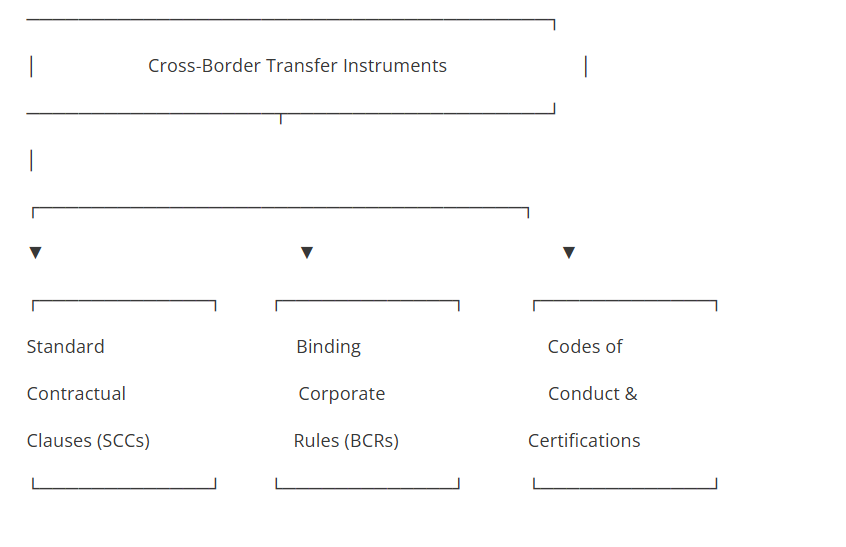
- Standard Contractual Clauses (SCCs)
SCCs are the most common and cost-effective mechanism for corporate entities. These are standardized, non-negotiable sets of data protection covenants embedded directly into commercial agreements or Data Processing Agreements (DPAs) between the exporter in Nigeria and the importer abroad. The clauses legally compel the foreign recipient to mirror NDPA-compliant security infrastructure and respect the statutory rights of Nigerian data subjects.
- Binding Corporate Rules (BCRs)
For multinational corporate groups with entities operating across several continents, BCRs serve as the gold standard. BCRs are internal, legally binding privacy codes of conduct developed by a corporate group. Once approved by the NDPC, they allow intra-company data transfers globally, removing the administrative burden of executing individual contracts for every internal data exchange.
- Approved Codes of Conduct & Certifications
Organizations may also rely on industry-specific codes of conduct or third-party privacy certification mechanisms that have been formally audited and endorsed by the NDPC. These serve as verified proof that the foreign recipient adheres to stringent organizational and technical safeguards.
Statutory Exemptions (Derogations)
In the rare event that a transfer cannot rely on an adequacy decision or an approved CBDTI, Section 43 of the NDPA provides narrow, highly specific exceptions. A cross-border transfer may legally proceed if it is strictly necessary for:
| Exemption Ground | Compliance Threshold |
| Explicit Consent | The data subject must give specific, informed, and unambiguous consent after being explicitly warned of the potential risks of the transfer due to the absence of an adequacy decision. |
| Performance of a Contract | The transfer is necessary to fulfill a contract between the data subject and the data controller (e.g., cross-border flight bookings or international banking transactions). |
| Public Interest & Legal Claims | The transfer is vital for public interest grounds, or for the establishment, exercise, or defense of a legal claim. |
| Vital Interests | The transfer is an absolute emergency required to protect the life or physical safety of the data subject. |
A Warning on Consent: Relying on user consent for systemic, everyday business operations is highly discouraged by regulators. Consent can be withdrawn at any time, which would immediately jeopardize the legality of your entire international data ecosystem.
Actionable Checklist for Compliance Officers
To insulate your organization from regulatory friction and ensure seamless operational continuity, your compliance and legal teams should implement the following four steps:
1.Map Outbound Data Flows
Phase 1: Discovery
Audit all software, cloud architecture, CRM databases, and third-party vendors to explicitly identify what personal data leaves Nigeria, where it is hosted, and who has administrative access.
2.Conduct a Transfer Impact Assessment (TIA)
Phase 2: Evaluation
Assess the legal system of the destination country. Determine if local laws (such as foreign surveillance mandates) might compromise the technical protections built into your systems.
3.Execute Data Processing Agreements (DPAs) with SCCs
Phase 3: Legal Remediation
Update all foreign vendor and intra-group service agreements. Ensure they contain NDPC-aligned Standard Contractual Clauses that hold foreign parties financially and legally accountable for data breaches.
4.File Regular Compliance Returns
Phase 4: Statutory Maintenance
As a Data Controller or Processor of Major Importance (DCPMI), ensure that documentation justifying your cross-border data transfer methodologies is explicitly detailed within your annual Data Protection Compliance Audit return filed with the NDPC.
The content of this article is intended to provide a general guide to the subject matter. Specialist advice should be sought about your specific circumstances.
[View Source]