

- within International Law topic(s)
- with Senior Company Executives, HR and Finance and Tax Executives
- in United States
- with readers working within the Accounting & Consultancy, Insurance and Healthcare industries
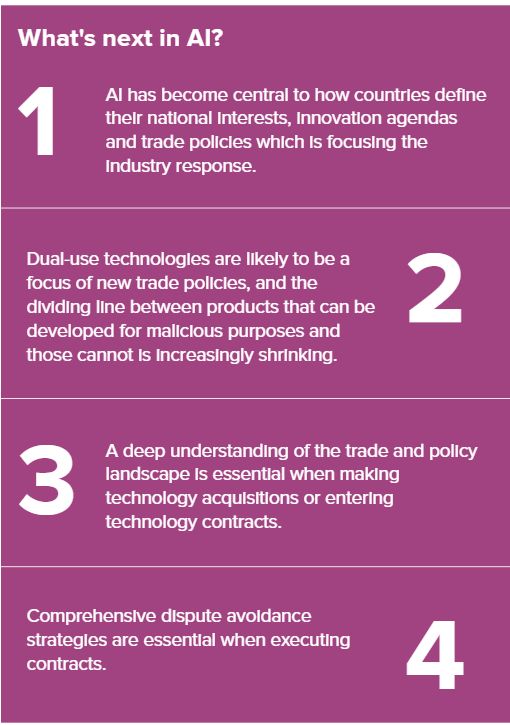
As artificial intelligence continues to accelerate economic growth, shifting trade policies in a dynamic trade environment are unsettling AI service providers and their supply chains. Trade directives and sovereign policies are affecting AI users, potentially restricting access to the advanced computing hardware on which AI systems depend, primarily through export controls on semiconductors, and causing friction to cross-border data flows via data localisation requirements and restrictions on access to foreign AI platforms and services. Collectively, these pressures are slowing innovation, while security concerns will cause governments to consider how to address the threat of AI as a dual-use technology.
Navigating trade tensions
AI has felt the effects of trade friction for some time. Under the previous administration, the US announced restrictions on the export of graphics processing units (GPUs) to China and Russia, among other countries.
The administration sought to protect US security and limit the advance of foreign AI industries. This had a major impact on the global semiconductor ecosystem, including major US exporters such as Nvidia, which saw a significant reduction in its market share in China (some estimates had this at as much as a USD 15 billion loss of sales).
Following the current administration’s tariff policy announcements in 2025, China countered with strict export controls on rare earth minerals, affecting global supply chains that support AI hardware (this was in addition to AI developments within China itself, most notably the launch of DeepSeek in early 2025 which garnered international attention).
In May 2025, the US Department of Commerce, Bureau of Industry and Security (BIS) announced it would rescind the previous Artificial Intelligence Diffusion Framework, which looked to enforce a worldwide licensing requirement on advanced semiconductors.
“The current US Administration is often referred to as being transactional,” says Peter Jones, a Sydney-based partner specialising in telecoms, technology and information transactions. “So, when we start looking at issues in and around AI, you can't divorce AI from the broader geopolitical, geostrategic, geo-trade issues that are happening.”
Trade between the US and China is shaping much of the AI industry. In March 2026, China outlined its new five-year plan in a bid to embed AI throughout its economy and establish itself as a leader in quantum computing.
Boosted by its huge manufacturing capacity, it has successfully developed its own LLMs, such as DeepSeek and Qwen, but its use of American LLMs is still expected to be vital to its worldwide position. “US LLMs definitely have a technical advantage versus domestic LLMs, especially when most Chinese companies these days are looking for opportunities to go global,” comments Justina Zhang, a Beijing-based technology partner at Kewei, the firm’s joint operation partner.
Whether the current speed of AI’s growth path will continue is not guaranteed, the combination of a traditionally interconnected digital world, a push towards increased technological self-reliance among major AI powers, and febrile global trade settings reflecting in part a challenging geo-strategic set of factors, means businesses must be prepared to adapt at speed.
Addressing concerns about malicious use
Predictions about the malicious deployment of AI are common. The reality is that trade negotiations and relationships are already subject to concerns over AI and its potential as a ‘dual-use’ technology – the potential repurposing of AI technology for malicious purposes.
The Wassenaar Arrangement in 1996 brought together 42 different countries which sought to regulate military and so-called ‘dual-use’ goods and technologies with the intention of preventing rogue states from accessing products that could be used for military purposes, such as electronics, computers and lasers. In general, the various countries’ regimes implemented to reflect the Wassenaar Arrangements do not include AI as a specific item subject to regulation. Given the potential use of AI technologies as an enabler of potential malicious outcomes, it is expected that individual nations will consider their respective export control regimes in connection with emerging technologies.
For example, in September 2025, the European Commission adopted a Delegated Regulation covering the European Union dual-use export control list. The updated control list adds new dual-use items such as quantum technology and semiconductor manufacturing.
However, the challenges around providing export controls on non-tangible items can be seen by the low cost drones used by Iran. “What makes a drone most effective is software which provides for targeting and target identification – it's got less to do with the hardware,” says Jones. "In the area of export controls, items such as propulsion systems and avionics are often comparatively obvious; what we're looking at now is off-the-shelf, publicly available AI applications that are deployed in a manner in which they were never intended.”
He also points to AI company Anthropic’s dispute with the US Department of Defense, linked to the business’s concerns about the use of its AI tools in mass surveillance and fully autonomous weapons. Jones expects this to be an ongoing political theme.
“The next wave of trade policy is likely to be around concerns over the deployment of advanced AI. An AI model in one jurisdiction may look completely harmless but could potentially have a very rapid dual use impact in terms of things like a global cyber-attack,” he warns.
Mitigating trade friction risks
Constant assessment of risk exposure when deploying or adopting AI tools and studying the direction of government policy and trading relationships are both vital in mitigating trade friction risks.
With supply chains this long and this complex, disruption is not a remote possibility but a near certainty.
Charlie Morgan
Partner, London
While paying close attention to policies connected to potential dual-use, that is, the risk that AI technologies developed for commercial or civilian purposes may be repurposed for harmful, military or surveillance applications as referred to above, organisations should also think about long-term resilience when onboarding suppliers, says London-based arbitration partner Charlie Morgan.
"A critical question for leadership is to understand where vulnerabilities lie across the supply chain, not just risks arising from a direct counterparty relationship. With supply chains this long and this complex, disruption is not a remote possibility but a near certainty. And yet, when entering a transaction, there can be a reluctance to stress-test what happens when things go wrong."
And when it comes to things going wrong, businesses would benefit from considering disputes risks early to protect value over time. “The commercial value and protections you negotiate into a contract are only ever as strong as the dispute resolution mechanism that stand behind them,” concludes Morgan.
The content of this article is intended to provide a general guide to the subject matter. Specialist advice should be sought about your specific circumstances.
[View Source]


