

Property disputes can become extraordinarily expensive, particularly when they escalate to full court proceedings. Understanding the costs involved in TOLATA (Trusts of Land and Appointment of Trustees Act 1996) claims and exploring alternative dispute resolution methods can save you tens of thousands of pounds while achieving better outcomes.
At Duncan Lewis Solicitors, our property dispute specialists help clients navigate the financial aspects of property disputes, exploring cost-effective mediation and negotiation strategies before resorting to expensive litigation.
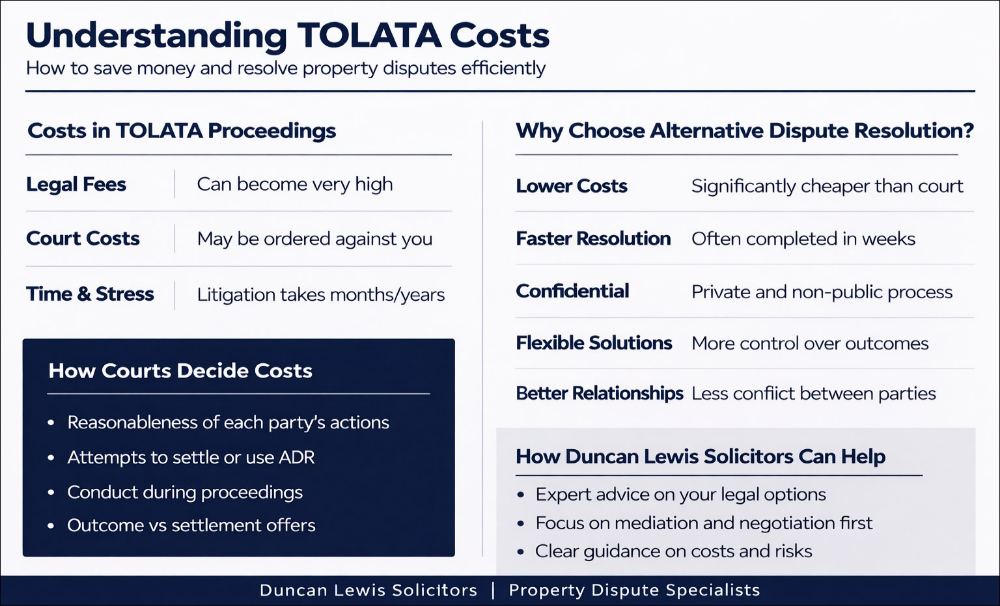
Costs in TOLATA Proceedings
Legal costs represent a major concern in property disputes. TOLATA cases can become expensive, particularly if they proceed to a full trial.
How Courts Deal with Costs
The general rule is that costs follow the event—the losing party typically must pay the other party's costs. However, in property disputes between co-owners, courts sometimes make no costs order, recognising that both parties had legitimate interests to protect.
The court may order one party to pay the other party's costs entirely, pay a proportion, or make no order at all. Factors influencing costs orders include:
- The reasonableness of each party's position
- Whether settlement offers were made
- Conduct during proceedings
- Whether ADR was unreasonably refused
- The outcome compared to any settlement proposals
Cost Consequences of Refusing ADR
Courts increasingly penalise parties who unreasonably refuse to attempt mediation or negotiation. Even if you ultimately win your case, refusing ADR without good reason may result in a costs order against you for the period after the refusal.
This makes engaging with alternative dispute resolution not just sensible but potentially essential to protect your position on costs.
Alternative Dispute Resolution: Mediation and Negotiation
Before embarking on TOLATA proceedings, parties should seriously consider mediation or other forms of negotiation. ADR offers several advantages over court proceedings:
- Significantly lower costs compared to litigation
- Faster resolution—mediation can conclude in weeks rather than the months or years court cases take
- Confidential process, unlike public court hearings
- Greater flexibility in outcomes
- Less adversarial, which can be important for ongoing relationships
How Mediation Works
In mediation, an independent mediator helps the parties explore options and reach an agreement. The mediator doesn't impose a solution but facilitates communication and helps identify common ground.
Many property disputes can be resolved through mediation, particularly when both parties are willing to compromise. Solutions might include:
- One party buying out the other's interest at an agreed price
- Delaying sale until a specified future date
- Agreeing beneficial ownership shares and sale terms
- Refinancing arrangements that allow one party to remain in the property
Agreements reached in mediation can be made legally binding through a consent order approved by the court, providing certainty without the expense and uncertainty of a contested hearing.
When Mediation May Not Succeed
Mediation requires both parties to engage in good faith. It may not work when:
- One party refuses to participate
- There's a significant power imbalance or history of abuse
- Positions are too entrenched
- Complex legal issues require court determination
Even when mediation doesn't resolve everything, it often narrows the issues in dispute, saving time and costs if court proceedings become necessary.
Costs of Legal Representation
While legal costs are a legitimate concern, attempting to navigate TOLATA proceedings without obtaining appropriate legal advice can be extremely risky. The complexity of trust law, conveyancing principles, the Civil Procedure Rules, and court procedures should be considered.
Most property solicitors offer initial consultations to assess your case and explain likely costs.
How Duncan Lewis Solicitors Can Help
At Duncan Lewis Solicitors, our property dispute team has extensive experience helping clients resolve TOLATA disputes efficiently and cost-effectively. We understand that property disputes are rarely just about money—they involve homes, relationships, and often children's wellbeing.
Our Approach
We take a pragmatic, client-focused approach to resolving property disputes:
- Clear advice on your legal position: We provide honest, realistic assessments of your prospects and the potential outcomes
- Strategic planning: We develop a strategy aligned with your goals, whether that's negotiating a buyout, forcing a sale, or establishing your beneficial interest
- ADR first: We actively explore mediation and negotiation to resolve disputes without court proceedings whenever possible
- Robust litigation: When court proceedings are necessary, we provide experienced representation through all stages
- Transparent costs: We explain likely costs upfront and keep you informed throughout
The content of this article is intended to provide a general guide to the subject matter. Specialist advice should be sought about your specific circumstances.
