- within Government and Public Sector topic(s)
- in United States
- with readers working within the Media & Information industries
- within Real Estate and Construction, Law Practice Management and Law Department Performance topic(s)
- with Finance and Tax Executives
Key Takeaways:
- Outcome-based budgeting helps you allocate resources according to measurable results, not historical spending patterns.
- Traditional budgeting often reinforces outdated priorities and understates emerging community needs.
- A priority-driven approach promotes transparency, accountability, and long-term fiscal resilience.
State and local governments are facing increasingly complex financial pressures. Rising operating costs, aging infrastructure, workforce challenges, and growing community expectations are straining budgets that were already stretched thin.
When revenue growth doesn't keep pace with demand, traditional budgeting approaches — starting from last year's numbers and adjusting incrementally — offer little insight into where resources are actually needed most. This makes it harder to allocate limited dollars in ways that genuinely improve outcomes for residents.
To move beyond reactive budgeting, agencies need a framework that aligns spending with results, prioritizes high-impact programs, and helps communicate the rationale behind difficult decisions.
Why Traditional Budgeting Often Falls Short
Incremental budgeting assumes that past allocations are the best predictor of current needs. While simple, this approach can reinforce outdated practices and mask emerging gaps. Over time, it can:
- Lock in longstanding spending patterns even if priorities have shifted
- Underfund services that are increasingly critical to the community
- Reduce opportunities to assess the true value delivered by programs
- Encourage short-term fixes, like tapping one-time revenues, rather than addressing underlying fiscal challenges
Communities are changing faster than budgets often allow. If your current process leaves you reacting to crises rather than proactively addressing priorities, it may be time to explore a more strategic approach.
A New Perspective: Outcome-Based Budgeting
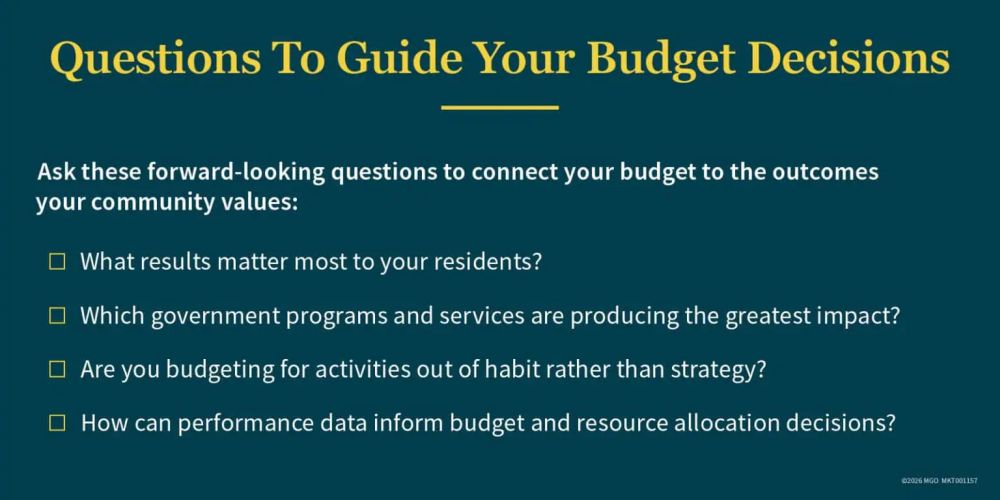
Outcome-based budgeting — also called priority-driven budgeting — starts with a different question: "What results matter most to our residents, and how can we use resources to achieve them?" This approach shifts the focus from inputs and line items to measurable results.
Instead of simply adjusting department allocations, you begin by identifying community priorities. This may involve workshops with elected officials, leadership teams, and resident groups to define goals — such as improving public safety, enhancing infrastructure, or expanding access to services.
Once priorities are clear, you can examine how current programs support those outcomes and where adjustments or reallocations are needed.
From Planning to Action
Moving from theory to practice requires a structured process. A typical outcomes-based budgeting cycle may involve:
- Establishing shared priority areas with key stakeholders
- Mapping current programs to those priorities
- Scoring activities based on impact and alignment
- Comparing value delivered relative to costs
- Redirecting funding toward high-impact programs
This approach helps you make tough trade-offs with a clear rationale and provides transparency when communicating with elected officials and the public.
Measuring Success Beyond Spending
Perhaps the most transformative aspect of outcomes-based budgeting is redefining what success looks like. Instead of focusing only on whether departments stay within budget, you evaluate whether their work advances community priorities. This shift strengthens accountability and encourages departments to collaborate across traditional silos.
It also improves communication with stakeholders. Residents and elected officials gain clarity on how tax dollars are spent and what results they can expect. Departments can better demonstrate the outcomes of their work, and your organization can respond more nimbly when community needs evolve.
Building a Sustainable Future
Outcome-based budgeting is more than a procedural change — it's a cultural shift. It challenges leadership and staff to think strategically about resource allocation and the value of each program. When embedded into your budgeting cycle, it helps agencies:
- Address structural imbalances and reduce reliance on one-time solutions
- Respond more quickly to emerging priorities
- Make data-driven decisions with confidence
- Build trust with stakeholders by linking spending to results
By focusing on results rather than inputs, your budget becomes a roadmap for achieving your community's goals. Over time, this approach fosters clarity, resilience, and long-term fiscal sustainability, even amid economic uncertainty.
As you prepare for the next budgeting cycle, consider whether outcome-based budgeting can help you align resources with the priorities your residents value most. A more strategic, transparent, and sustainable budget starts with focusing on what truly matters.
How MGO Can Help
Our State and Local Government team supports public sector agencies nationwide as they look for ways to strengthen fiscal sustainability, improve transparency, and align resources with strategic goals. We help you modernize your budgeting practices, evaluate program performance, and build the frameworks needed to deliver meaningful results.
The content of this article is intended to provide a general guide to the subject matter. Specialist advice should be sought about your specific circumstances.