

- in North America
- within Antitrust/Competition Law topic(s)
- in North America
- with readers working within the Aerospace & Defence industries
INTRODUCTION
The 2026 Minnesota Legislative Session begins February 17, 2026, and will take place during an exceptionally turbulent period for Minnesota. The deadly ICE shootings and the continuation of Operation Metro Surge follow a year marked by acts of violence, including the assassination of Speaker Emeritus of the House, Melissa Hortman, her husband, and the severe injury of Senator Hoffman and his family. The school shooting at Annunciation in Minneapolis last fall brought debate on gun control and a brief uncertainty of a special session, which ultimately did not happen due to the closely divided legislature. In addition, deaths, criminal convictions, officials seeking other political offices, and other factors have resulted in eight special elections, further disrupting the pace of a closely divided legislature.
The House Democrats will be under the new leadership of Representative Zack Stephenson (DFL–35A). He was a close confidant to Melissa Hortman and was elected by the House DFL Caucus to unite and lead the caucus following the tragic events of June 14, 2025.
The Legislature will work toward a May 18, 2026, adjournment, which will lead directly into the campaign season for all 201 legislative districts. Senator Amy Klobuchar has recently announced she will be running for Governor and will likely be the endorsed democrat candidate. She will potentially face one of three House GOP caucus members in the general election, including the sitting Speaker of the House, Representative Lisa Demuth (R-13A).
CONTEXT
Because the Legislature enacted a two-year budget last session, no budget action is required in 2026. That said, lawmakers will find no shortage of issues to be deliberated. Fraud is expected to be a central focus of both the session and the election, as lawmakers confront multiple failures in fiscal safeguards that have resulted in significant misuse and abuse of state funds. We can anticipate daily hearings regarding state and federal programs facilitation and funding. Other issues expected to be under consideration include a bonding bill, potential changes to Paid Family and Medical Leave, and proposals related to gun control and school safety. Given the current political and social climate, it would not be surprising if very little passes the Legislature, as partisan brinkmanship sweeps up even noncontroversial policy matters and prevents action before adjournment.
LOOKING AHEAD
Committee Deadlines
March 27th – Combined First and Second Deadline, policy bills and companion bills must be acted on favorably
April 17th – Third Deadline, fiscal bills must pass out of finance committees
March 19th – Eid al-Fitr Recess
March 27th – April 7th – Easter/Passover Recess
Important Election Information
May 19, 2026 – June 2, 2026 at 5 p.m. – State and Federal candidate filing period 2026
February 3, 2026 – Precinct Caucuses
May 29–31, 2026 – DFL State convention (Rochester, MN)
May 29–30, 2026 – GOP State convention (Duluth, MN)
August 11, 2026 – Primary Election
November 3, 2026 – General Election
Seats up for election: Governor, Attorney General, Secretary of State, State Auditor, all 201 House and Senate members, Congressional Delegation and one Senator.
COMPOSITION
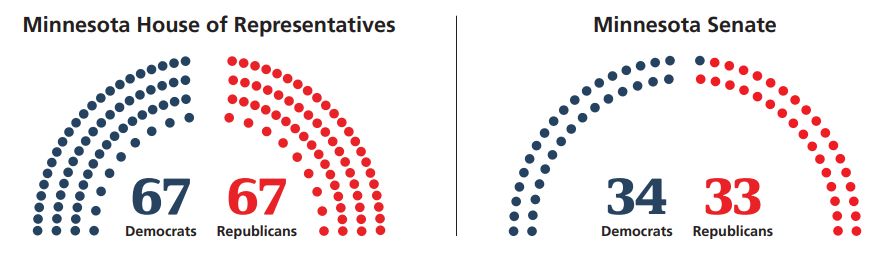
Despite numerous special elections, the Minnesota House remains tied at 67 democrats –67 republicans. The speakership remains with the republicans and the power sharing agreement from 2025 is still in place. This means there are DFL and republican co-chairs to each committee in the House. In the senate, the DFL holds a one-seat majority at 34-33.
Functionally, passing legislation in this environment requires bipartisan collaboration and majority votes of the full legislative body—not merely those present and voting. The primary exception is the bonding bill, which requires approval by a two-thirds majority of the body. Achieving that level of bipartisan agreement will be particularly difficult in an election year, with Minnesota increasingly under a national microscope.
The content of this article is intended to provide a general guide to the subject matter. Specialist advice should be sought about your specific circumstances.
[View Source]
