

- within Transport, Media, Telecoms, IT, Entertainment and Employment and HR topic(s)
- with Inhouse Counsel
Europe ended 2025 with M&A healthier in value than in count, shaped by macro caution, policy noise, and a decisive tilt toward quality assets in strategic sectors. As we enter 2026, there is a consensus on cautious optimism: more activity, still selective, with financing and policy as the gating items. For buyers prepared to move with clarity on synergies, integration, and capital, 2026 looks set to reward conviction.
As we enter 2026, there is a consensus on cautious optimism: more activity, still selective, with financing and policy as the gating items.
Resilience in 2025
European M&A in 2025 was a story of value resilience amid volume fragility. After tentative signs of recovery in late 2024, activity through the first half of 2025 perged: aggregate deal values strengthened while overall volumes slipped. Boards and investment committees concentrated on fewer, higher-conviction transactions, signalling continued appetite for quality assets despite a more selective approach. This pattern reflected a market where confidence was returning, but prudence remained the dominant theme.
Geopolitical shocks and trade-policy uncertainty slowed momentum early in the year, particularly for cross-border transactions. However, mid-market resilience and sector-specific strength kept Europe's M&A engine running. Despite macroeconomic headwinds, small and mid-cap deals remained robust, supported by abundant private capital and strategic buyers pursuing digital transformation and operational efficiency.
Macro conditions were a key swing factor. The European Central Bank shifted from 2024's steady easing cycle to a single rate cut in June 2025 – bringing the deposit rate to 2.0% – and then paused for the remainder of the year, citing balanced risks and sticky services inflation. Lower rates helped narrow buyer-seller valuation gaps and improved financing math for quality assets. Yet, policy uncertainty, notably tariff-related headlines, kept many processes elongated and selective (as we discuss in our article Tariffs cause tension). The June cut and subsequent "on hold" stance framed a cautious but moderately supportive backdrop for dealmaking.
Regulation and geopolitics remained primary headwinds. Trade-policy uncertainty in spring 2025 briefly froze cross-border pipelines. Even so, dealmaking recovered into the second half, with transformational and digitalisation-driven rationales rising on the buy-side and non-core pestments and distressed sales leading the sell-side.
Sector performance was uneven but instructive. Industrials and energy transition, technology, media & telecom (TMT) – especially AI and digital infrastructure – and financial services were the principal engines of activity. In the mid-market, preference for recurring revenues and tech-enabled models drove strong deal flow in TMT, engineering/manufacturing, and business services. At the large-cap level, energy/power, healthcare, and financials dominated by value, while technology led by volume as buyers targeted resilient, capability-enhancing assets.
Private capital and private credit played a more prominent role in 2025. Sponsors re-engaged with add-ons and selective platforms as dry powder remained abundant, with improved entry and exit conditions from 2024 carrying into 2025.
Infrastructure and digital assets attracted significant capital even as infrastructure dry powder ratios compressed, underscoring the pull of data centres and energy security themes.
Constructive caution for 2026
Our outlook for 2026 – consistent with what we hear from European M&A market participants – remains optimistic but 'cautiously constructive'. We can expect more activity and continued deal volume growth in 2026 for both corporates and private capital sponsors, building on 2025 momentum despite tighter financing conditions which will continue to favour well-capitalised bidders.
Three forces should underpin the anticipated upswing:
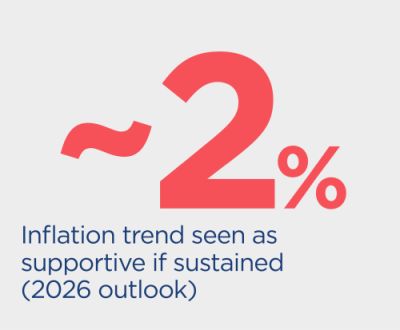
- greater macro visibility if rates remain near current levels and inflation trends around 2% stick;
- portfolio reshaping by corporates (carve‑outs, spin‑offs) and private capital exit pressure to return capital; and
- AI and software‑enabled capability deals cutting across sectors.
We expect Europe's rebound to skew toward industrials & chemicals, TMT, and energy – sectors aligned with digitalisation, decarbonisation, and supply‑chain resilience. Energy transition (grids, storage, flexibility), digital infra (data centres, fiber), and AI‑adjacent software/services are likely to command premium processes.
Risks and execution challenges
What could derail the recovery? First, financing: even with the European Central Bank's rates off the peak, access to standard bank credit facilities is expected to be tighter in 2026. Second, valuation friction could persist if public multiples and private marks perge. Third, policy shocks – from tariffs to merger‑control and FDI/FSR scrutiny – could elongate timetables and complicate cross‑border certainty.
Key considerations for dealmakers in 2026
There are three notable elements that dealmakers will have to consider in 2026 for their intended transactions in Europe:
- Design around financing reality: Expect greater reliance on private credit and hybrid structures; pre-wire staple financing and consider earn-outs to bridge valuation gaps.
- Anticipate regulatory choreography: Build antitrust, FDI, and foreign subsidy regulation (FSR) pathways into the critical path with mitigation packages – behavioural and carve-out remedies – ready.
- Prepare for extended processes: Sale and negotiation timelines will remain long and complex. Sophisticated, imaginative solutions will be essential to sign and close deals amid heightened uncertainty.
Europe enters 2026 with a cautiously constructive outlook. For those prepared to act decisively, with robust financing strategies and regulatory foresight, the year promises opportunities – albeit in a market that rewards patience, creativity, and conviction.
See our chapters on other European regions below.
The content of this article is intended to provide a general guide to the subject matter. Specialist advice should be sought about your specific circumstances.
