- within Technology topic(s)
- with Inhouse Counsel
- with readers working within the Business & Consumer Services, Technology and Law Firm industries
Executive Summary
As the integration of alternative data with artificial intelligence (AI) systems accelerates, investment firms are experiencing both expanded opportunity and heightened responsibility.
AI is proving highly beneficial in surfacing new signals, streamlining research, and unlocking new sources of alpha from complex, high‑velocity datasets. At the same time, its use is heightening firms' exposure to model risk, governance gaps, and evolving data rights— requiring firms to implement disciplined controls, auditable decisioning, and a clear data provenance strategy to effectively translate innovation into durable performance.
These conclusions are based on Lowenstein Sandler's latest survey of investment advisers at private fund managers (private equity firms, hedge fund managers, and venture capital firms). Since 2019, the firm has conducted an annual survey (except in 2020) to understand the role of alternative data in the investment community. Now a global market estimated at over $15 billion, alternative data includes forms of information not contained in company filings, press releases, analyst reports, or other traditional sources, such as credit card transactions, satellite imagery, and mobile device data.
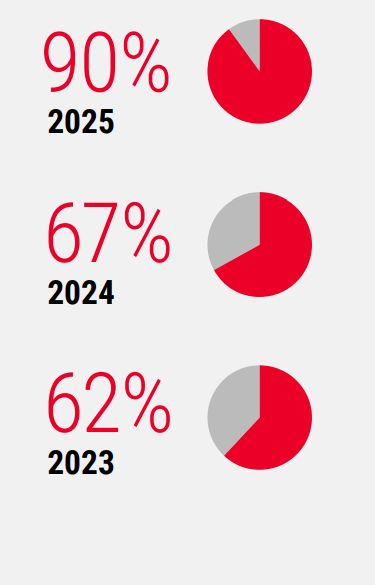
Results from the latest survey suggest the popularity of alternative data continues to grow. The percentage of respondents currently using alternative data reached 90 percent, up from 67 percent last year and 62 percent in 2023. Only 4 percent of respondents indicated that private fund managers do not expect to use alternative data in the future. Moreover, over two-thirds of respondents reported having alternative data budgets exceeding $1 million.
Total Alt Data Usage
Private Equity Firms, Hedge Fund Managers, and Venture Capital Firms
New Opportunities, New Challenges
Of course, any analysis of the alternative data market is
incomplete without considering the impact of AI, which has become
central to operations across investment firms.  Private fund managers are applying
it to multiple functions, most notably investment research,
portfolio monitoring, and data summarization. AI use is no
longer confined to quantitative or innovation teams— it
supports everything from front-office decision-making to human
resources and recruiting.
Private fund managers are applying
it to multiple functions, most notably investment research,
portfolio monitoring, and data summarization. AI use is no
longer confined to quantitative or innovation teams— it
supports everything from front-office decision-making to human
resources and recruiting.
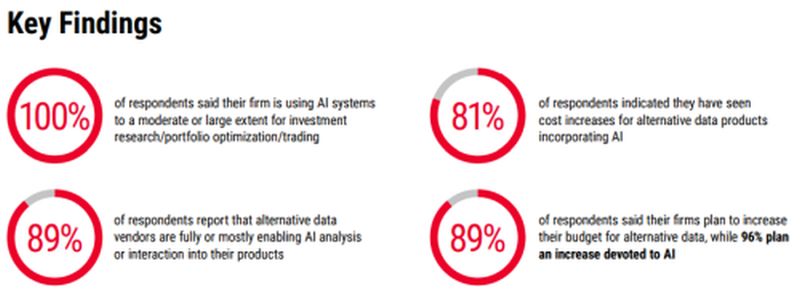
At the same time, AI has raised new concerns about— among other things—data security, regulatory scrutiny, vendor reliability, and the risk of acquiring material nonpublic information. Those concerns are particularly salient in the alternative data ecosystem, where vendors are adding AI-enabled features. Survey results show that firms are encountering higher costs, tighter licensing terms, and greater restrictions on AI-related data usage, particularly for model training. The result is a more complex commercial and governance environment.
Like practically every segment of the economy, alternative investment is being reshaped by AI. Investment firms are leveraging it across their business, including by deriving new insights from the data they collect to make decisions. But effective adoption isn't so simple. The challenges involved will require human judgment to get it right.
— Scott H. Moss
Partner
Chair, Fund Regulatory & Compliance
Co-chair, Investment Management Group
Lowenstein Sandler LLP
Still, none of those challenges seem to slow the integration of AI and alternative data. There is evidence that firms are tackling many of the challenges—for example, nearly nine in 10 respondents said they have formal policies in place for the use of AI in investment and trading.
Explosive Growth, Fueled by AI
To most of the professional investment community, alternative
data is an old story, but its explosive growth isn't. The intelligence firm Neudata estimates that the alternative
data market for investment managers could reach nearly $40 billion
by 2030, double its current size. Further, in 2024, market
spending on alternative data grew 34 percent, according to Neudata,
exceeding the 21 percent average annual growth since 2020.
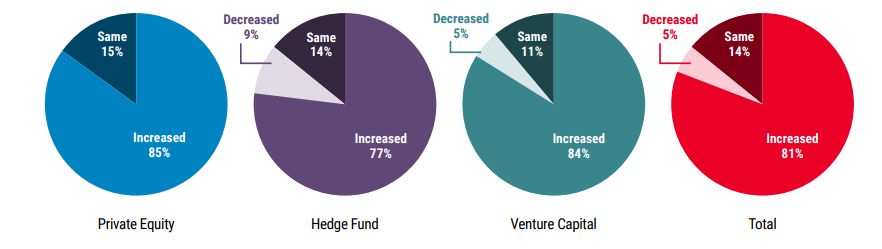
hose numbers jibe with the findings in this survey—the 90 percent of survey respondents who said they are currently using or plan to use alternative data is higher than in the previous two years. Enthusiasm for its use is evident across asset classes, including private equity and venture capital, which saw significant increases compared with prior surveys.
Which of the following describes your firm's current level of alternative data usage?
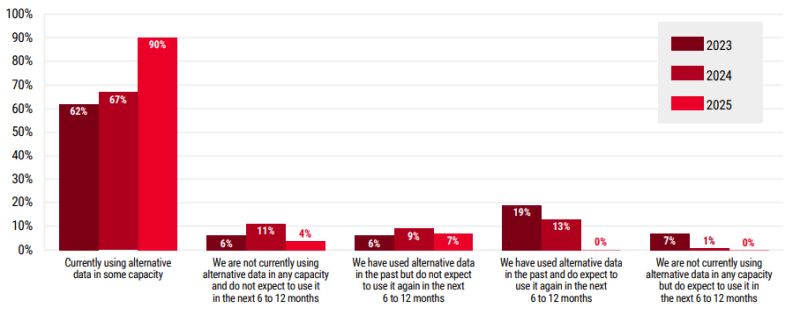
Which of the following describes your firm's current use of alternative data in 2024 and the first half of 2025?
To view the full pdf, click here.
The content of this article is intended to provide a general guide to the subject matter. Specialist advice should be sought about your specific circumstances.