

- within Compliance topic(s)
Patent attorneys spend a lot of time explaining two deceptively simple concepts: novelty and obviousness. Both rise and fall on one thing: prior art. Most inventors assume prior art means a patent or some obscure technical paper written by someone surviving on cold brew and conference coffee.
That assumption is wrong.
Prior art is anything made available to the public before you file your patent application. Not just patents. Not just academic papers. We are talking about movies, television shows, YouTube videos, blog posts, product demos, and comic books.
…and occasionally, Borat.
There is an actual patent application that tried to claim what can best be described as a sling-style male garment (U.S. Patent Application No. 12/071,878 – Publication: US20090216171). The application described the invention using the kind of terminology patent lawyers love: structural support members, anchoring points, tension distribution, and other language designed to make a piece of fabric sound like a suspension bridge.
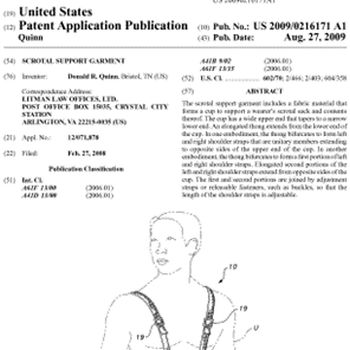
The examiner read the application and had a moment of déjà vu.
Why? Because millions of people had already seen essentially the same garment in the film Borat: Cultural Learnings of America for Make Benefit Glorious Nation of Kazakhstan. The examiner cited a screenshot from the movie as prior art.
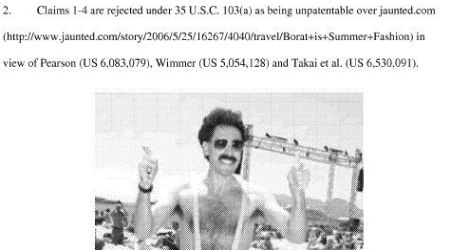
Imagine opening your Office Action and discovering the rejection includes Borat standing on a beach wearing the claimed invention. That is not the moment you want to begin explaining obviousness doctrine to your client.
As Borat might say: “Great success… for the examiner.”
And Borat is not the only comedian who has ruined someone’s patent dreams.
In another well-known example, a 1949 Donald Duck comic showed characters raising a sunken ship by filling the hull with ping-pong balls to displace water. Years later, a Dutch engineer filed a patent application describing a buoyancy-based salvage method using spherical displacement elements (Dutch application NL 6514306).The application was technically correct and elegantly written.
Unfortunately, one famous duck had already solved the problem decades earlier.
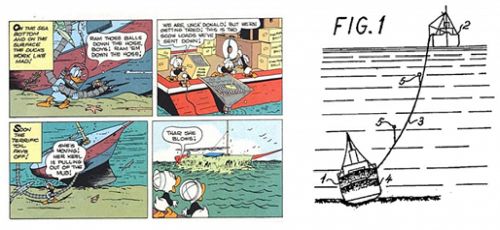
The examiner essentially responded: “Quack.”
Result: rejection.
Once prior art appears, the next phase of the conversation with an inventor tends to follow a very predictable script: “But mine is different.”
The explanations usually follow familiar themes. The material is different. The shape is slightly different. A buckle has been added. Maybe the color changed. Sometimes the pitch is delivered with great confidence, as if the Patent Office has never encountered a buckle before.
Patent law is generally unimpressed.
If the core idea is already public, the analysis shifts from novelty to obviousness. At that point, the question becomes whether the differences would have been obvious to someone skilled in the field. Minor tweaks rarely save the day. Adding buckles to Borat’s swimsuit does not suddenly transform it into a breakthrough in garment engineering.
Another misconception is that patent examiners only search patent databases. That may have been closer to reality twenty years ago. Today, examiners search patents, academic publications, archived websites, product documentation, videos, historical media, and just about anything else that has ever been made publicly available.
Now we are entering the era of AI-assisted search tools capable of analyzing enormous bodies of information. Soon enough, examiners may have tools powerful enough to comb through the entire internet in seconds. In Borat terms, “Very nice.”
Before filing a patent application, the question should not simply be: “Has anyone patented this?”
The better question is: “Has anyone shown this to the public anywhere?”
Because once an idea becomes public, even in a movie scene or a comic panel, it can become prior art. The good news is that with the rise of AI-assisted search tools, prior art searching has become much easier. At a minimum, it is worth running a quick search before investing too much time in your next bathing suit breakthrough. Otherwise, you may find yourself opening an Office Action that cites a screenshot of Borat standing on a beach, at which point your legal arguments may feel like you just showed up to the beach without a towel.
At that point, the best response may simply be,“Wa wa wee wa.”
Then start brainstorming the next invention.
The content of this article is intended to provide a general guide to the subject matter. Specialist advice should be sought about your specific circumstances.
[View Source]