

Summary:
On 18 December 2025, the draft Law on Economic Freedom was submitted to the State Great Khural. The purpose of the draft law is to guarantee the economic rights of entrepreneurs, create a favorable economic environment, and reduce state intervention in economic activities. Once enacted, it shall apply to all individuals and legal entities engaging in any business or economic activities within the territory of Mongolia, except for those activities expressly prohibited by law.
Definitions:
- "Economic freedom" means the freedom of individuals and business entities to engage in economic activities, which may be restricted solely on the grounds and in the manner prescribed by the Constitution and other applicable laws;
- "Entrepreneur" means an individual or business entity engaged in entrepreneurial activities;
- "Business entity" means a company, partnership, cooperative, state or locally owned enterprise operating on a commercial basis and registered with the state registration authority, as well as other comparable entities obligated to pay corporate income tax, including legal entities, non legal-entity organizations, and domestic or foreign legal entities whose principal activities are non-profit in nature but which generate income through the sale of goods, performance of works, or provision of services.
Ensuring guarantees for economic freedom:
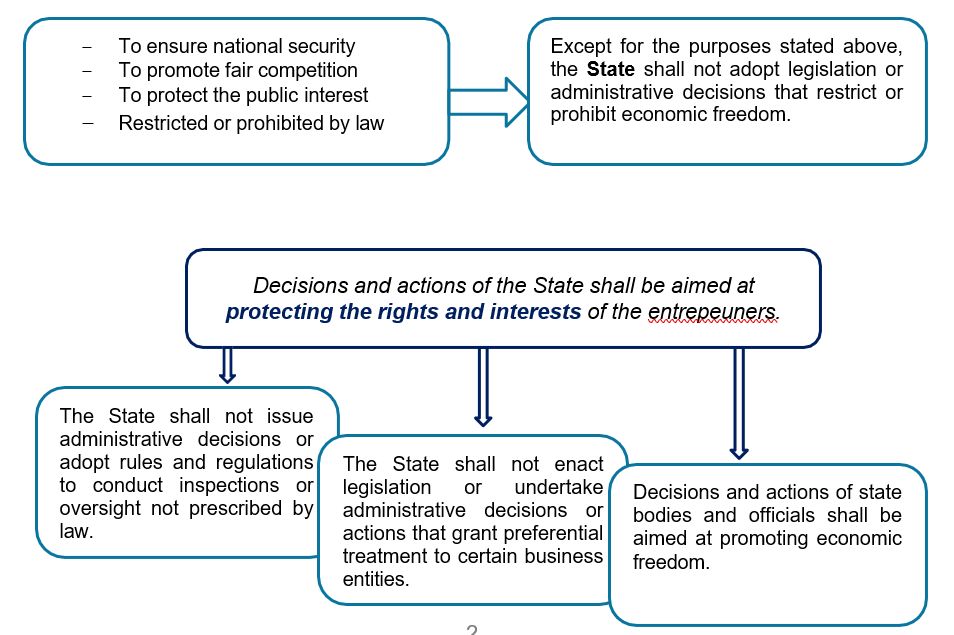
State Regulation of Business and Economic Activities:
In exercising state regulations over business and economic activities, the following conditions shall be ensured:
- Legislation and decisions shall be well-grounded and clearly defined;
- Information relating to legislation and decisions shall be transparent and publicly accessible;
- Requirements established by legislation and administrative decisions governing business and economic activities shall be sufficient for business operators to comply with and shall be predictable;
- Requirements established by legislation and administrative decisions governing business and economic activities shall not hinder the business operations of investors and business operators.
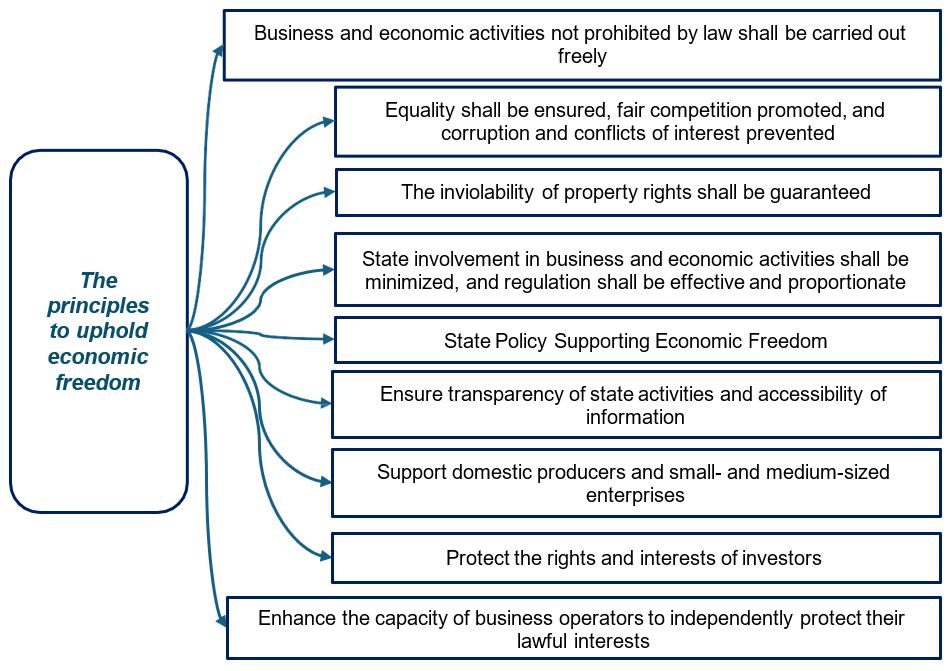
Principles to Be Observed by the State:
The primary objective of this draft law is to establish the principles for regulating the conduct of business and economic activities. This is significant in that any legislation or other legal act governing business or economic activities shall not be applicable if it violates these principles:
Cooperation Between the State and Business Operators:
In accordance with applicable legislation, the State shall delegate certain functions under its authority to business operators or private companies. These areas include:
- Educational services related to software and training provided by state schools;
- Healthcare services related to the management of treatment, diagnostics, and medical services;
- Development, maintenance, and repair of infrastructure and services;
- Public services related to waste management, cleaning, and public transportation;
- Technological services related to technological solutions by state
The State shall provide business operators with information or, except where restricted or prohibited by law, make such information publicly available free of charge and update it regularly. Furthermore, the State shall not require business operators to provide information or evidence that is already in the State's possession or that it is required to maintain.
Economic Policy Council:
An "Economic Policy Council", chaired by the Prime Minister, shall operate as a permanent consultative body between the State and business operators, to provide recommendations.
The Council shall have the following functions:
- To ensure private sector participation in decision-making by obtaining preliminary input, issuing opinions, and providing feedback from investor representatives on all draft laws and regulations related to the business and investment environment before submission to the Government;
- To conduct studies and provide recommendations aimed at eliminating gaps or inconsistencies in relevant legislation, improving its quality, attracting foreign investment, and enhancing coordination and coherence among ministries and agencies;
- To review complaints submitted by business operators in advance and issue recommendations and guidance.
Impact of the Draft Law on Business Operators:
This draft law provides regulatory measures to improve the legal status of investors and business operators in cases where there are overlaps, gaps, or conflicts between laws, or where a law is applied retroactively. In this way, it allows for the annulment of decisions adopted in violation of legislation or legally established procedures in accordance with proper procedures.
The law also ensures economic freedom by guaranteeing transparency and participation in policymaking and administrative processes that may affect the rights of business operators. This includes allowing individuals, legal entities, and professional associations to participate in, provide input on, and observe electronically the development of laws, regulations, and policies that may impact business operations.
If a business operator believes that their rights, freedoms, or lawful interests have been violated, they have the right to file a complaint against decisions or actions of state bodies or officials. State bodies and officials shall not refuse to accept explanations, petitions, or complaints submitted by business operators and shall ensure the uninterrupted processing of such complaints. This creates a legal framework ensuring that business operators can continuously exercise their right to seek remedies under the law.
Therefore, business operators are able to avoid multi-stage administrative procedures and conduct their activities under more flexible and transparent conditions.
Conclusion:
With the enactment of the Law on Economic Freedom, state involvement in the economy is reduced, creating a more favorable environment for conducting business activities.
Individuals and legal entities engaged in business are now able to exercise their economic freedoms and rights within the framework of the law. Under the functioning of the Economic Policy Council, business operators are provided opportunities to express their views on economic and related legal matters, and to ensure that their interests and rights are recognized and protected. Therefore, a favorable legal environment for conducting business activities has been established in Mongolia for both individuals and legal entities.
Sources:
- Draft Law on Economic Freedom (2025)
- Law on Corporate Income Taxation (2019)
The content of this article is intended to provide a general guide to the subject matter. Specialist advice should be sought about your specific circumstances.

