

- within Corporate/Commercial Law topic(s)
- with readers working within the Retail & Leisure industries
How delivery platforms are reshaping quick service restaurants, and what leaders must do now
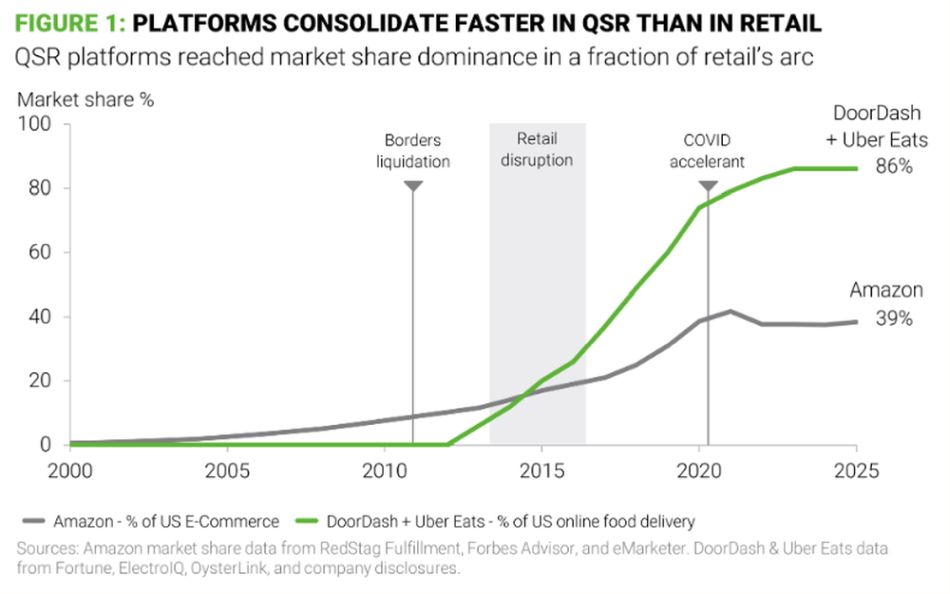
DoorDash and Uber Eats now control 85 percent of U.S. online
food delivery. At many QSR chains, third-party orders represent 20
to 30 percent of sales, a share that keeps growing even as traffic
softens and steep discounting compresses profitability. That
dependence extracts a toll: commissions squeeze margin while
customer data flows to the platform rather than the restaurant.
Aggregators have become too big to ignore, too costly to embrace
fully, and too entrenched to negotiate on equal terms.
Retail faced this moment a decade ago. When Borders outsourced
its online bookstore to Amazon in 2001, the decision seemed
logical. E-commerce was a fraction of total revenue. By 2015,
Borders was gone, and Amazon was on the agenda of every retail
board meeting. The math had become punishing: walking away from the
platform meant losing access to a growing share of demand but
staying meant funding a competitor's expansion. The risk was
not e-commerce itself, but ceding customer ownership, economics,
and execution control to a platform at the same moment it became
central to demand.
Sit in any QSR management meeting today and the parallels are
clear, but so is a crucial difference. It took Amazon 15 years to
capture 40 percent of U.S. e-commerce, while DoorDash and Uber Eats
consolidated the US online delivery market nearly twice as fast.
The window for response is narrower.
Platforms have already reshaped the industry. The question is which brands will act before the window closes.
Reclaiming control
The brands gaining ground are making choices that run counter to
conventional industry thinking. Three deliberate moves across
operations, marketing, and store portfolio are proving most
effective.
Operations: Own the peaks
Platforms now offer white-label fulfillment. DoorDash Drive and
Uber Direct let restaurants outsource delivery even for orders
placed through their own apps, dispatching gig drivers on the
brand's behalf. The model appears sound: variable costs, no
driver management, no fleet overhead.
The reality is more complicated. Third-party drivers work
multiple apps, chasing the best payouts. When dinner rush coincides
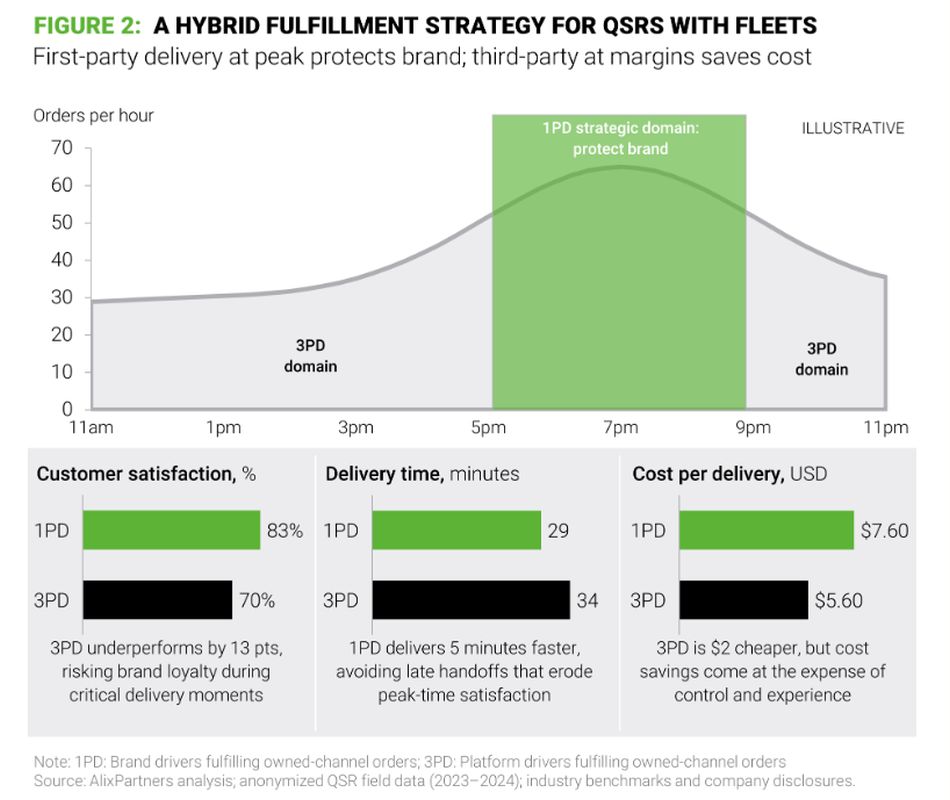
with surge pricing elsewhere, orders sit. AlixPartners'
analysis finds aggregator-fulfilled orders arrive five minutes
slower than first-party deliveries during peak windows, with
satisfaction scores 13 points lower.
For QSRs such as large pizza chains with dedicated fleets, the
strategic question is how to balance cost and control. Third-party
delivery costs roughly $2 less per order, a meaningful margin
advantage. Yet that savings erodes quickly if applied
indiscriminately, given peak periods are when brand reputation is
built or lost. The answer for most brands is a hybrid model:
first-party delivery at peak times to protect customer experience,
third-party delivery at non-peak to protect cost.
Domino's represents one extreme: first-party fulfillment for
all orders, regardless of origin or order time. When it partnered
with Uber Eats and DoorDash, it negotiated terms ensuring
Domino's drivers fulfill every delivery. The platforms provide
incremental demand; Domino's maintain operational
control.
Of course, not every brand has or needs Domino's delivery
infrastructure. For those fully reliant on third-party delivery,
the principle is the same even if the levers differ: kitchen
throughput, order accuracy, and handoff speed determine whether the
brand experience survives the last mile during peak times. A
perfectly staged order gives even a gig driver the best chance to
deliver on the brand promise.
Own the peaks, outsource the margins, and never cede control of the brand-defining moments.
Marketing: Reclaim the relationship
QSR marketing leaders often describe aggregator promotions as
"easy money" because platform visibility and order count
tend to move in tandem. But there is a critical distinction:
platform marketing is promotional spending, not brand-building.
Every dollar spent on a platform discount or placement fee further
dilutes margin on already thin orders, while doing nothing to build
the affinity that platforms are eroding.
The trap is self-reinforcing. The more a brand spends on
platform promotions, the more customers learn to find and order
through the aggregator. Over time, the relationship transfers from
the brand to the platform, and unwinding that dependency becomes
increasingly expensive.
The window may be narrower than expected: AlixPartners'
Restaurant Consumer Outlook shows that loyalty program influence,
after a decade of steady growth, has flattened in 2025.
Points-based programs alone are no longer sufficient to overcome
platform convenience.
The brands building durable positions are shifting investment
toward first-party channels: innovative loyalty programs,
app-exclusive offers, and direct engagement. Chipotle grew its
loyalty program from 8 million in 2019 to 40 million members in
2023 by making rewards exclusive to direct ordering. The goal is
not to abandon aggregators but to treat them as
customer-acquisition channels, with a deliberate path back to owned
relationships that protect margins and brand equity.
Store portfolio: Toward a healthy fleet
The benefits of location and dense physical store coverage have
diminished in a delivery-dominated environment that has steadily
taken share from walk-ins and drive-throughs.
What matters now is a healthy fleet that can consistently
execute. In our experience, top-quartile stores in a typical QSR
system generate three to four times the contribution margin of
bottom-quartile locations, yet development teams often treat the
portfolio as undifferentiated, spreading investment across
performers and laggards alike.
The most effective franchisors we advise are rethinking
development strategies by segmenting stores into distinct cohorts
and developing tailored action plans for each: targeted investment
for high performers, operational interventions for fixable
underperformers, and proactive exit strategies for locations that
cannot be turned around. For some brands, this means shrinking
before growing, a difficult message for boards accustomed to
unit-count growth as the headline metric.
A smaller, healthier fleet creates compounding advantages: it
attracts stronger franchisees who see a system that values
profitability over vanity metrics, it appeals to capital market
investors increasingly focused on unit economics rather than store
counts, and it generates the store-level cash flow needed to invest
in digital capabilities that will define competitive advantage in
the years ahead.
The window is open
Retail's Amazon moment produced clear winners and losers,
and the difference was timing. Brands that recognized the threat
early and invested in transformation survived and in some cases
thrived. Those that waited became cautionary tales swept up as
Amazon expanded to control roughly 40 percent of U.S.
e-commerce.
QSRs can learn from that history. Brands that maintain control
of the brand experience, build direct customer relationships, and
optimize fleets for profitability will create separation that
compounds over time.
Industry shifts are decided at such inflection points, before momentum becomes irreversible. For QSR, that time is now.
The content of this article is intended to provide a general guide to the subject matter. Specialist advice should be sought about your specific circumstances.
[View Source]
