

How restaurants should rethink value beyond short-term promotions
The playing field for restaurant pricing has changed as the industry enters 2026. Menu prices have climbed steadily, outpacing inflation. Consumers, meanwhile, are signaling affordability fatigue. Promotions continue to drive bursts of traffic, but those gains fade as quickly as they appear. And perhaps most importantly, performance has become deeply local: what works in one market, or even one cluster of stores, may fail in another just miles away.
The value equation has shifted, and as a result operators and brands must evolve how they think about pricing, value, and execution in 2026.
The facts behind the shift
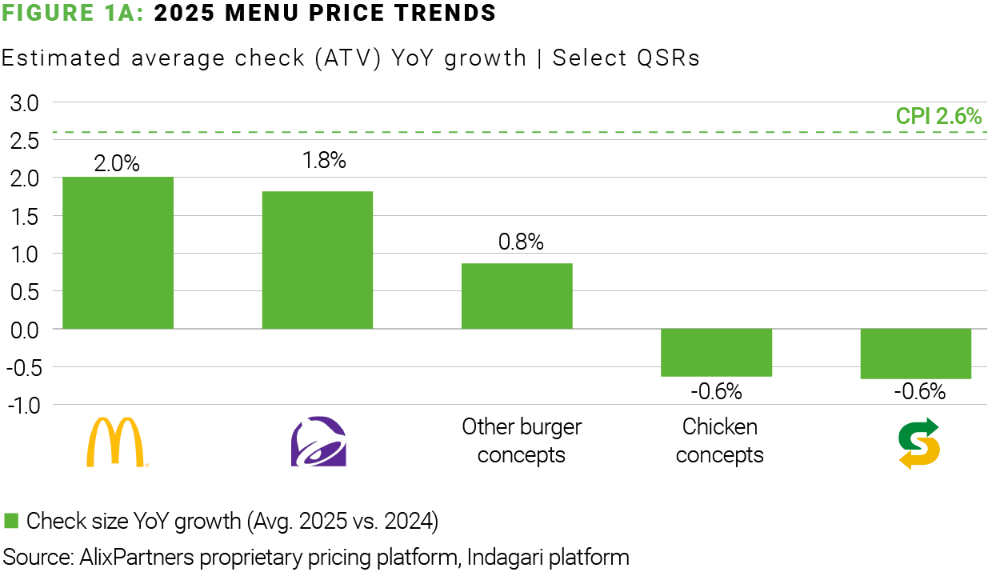
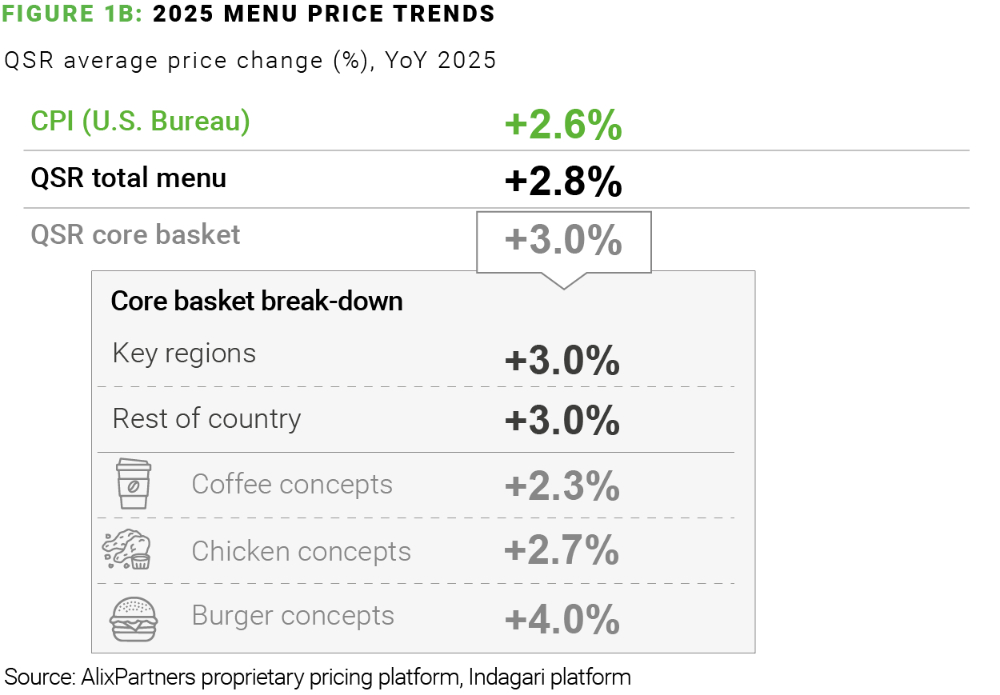
Over the past year, many QSR brands leaned on price to offset cost pressures. We used the AlixPartners Proprietary Pricing Platform to analyze 90,000 restaurant locations and hundreds of thousands of menu items, finding that on average, menu prices increased slightly faster than inflation (+3.0% core basket items and +2.8% overall prices vs. +2.6% CPI). However, average transaction value did not keep pace, signaling trade-down behavior, product mix shifts toward lower-priced items, and increased promotional dilution.
AlixPartners’ recent consumer research reinforces this pattern:
- 45% of respondents reported intentionally reducing restaurant spending
- 50% said they were trading down within menus (i.e., choosing cheaper proteins)
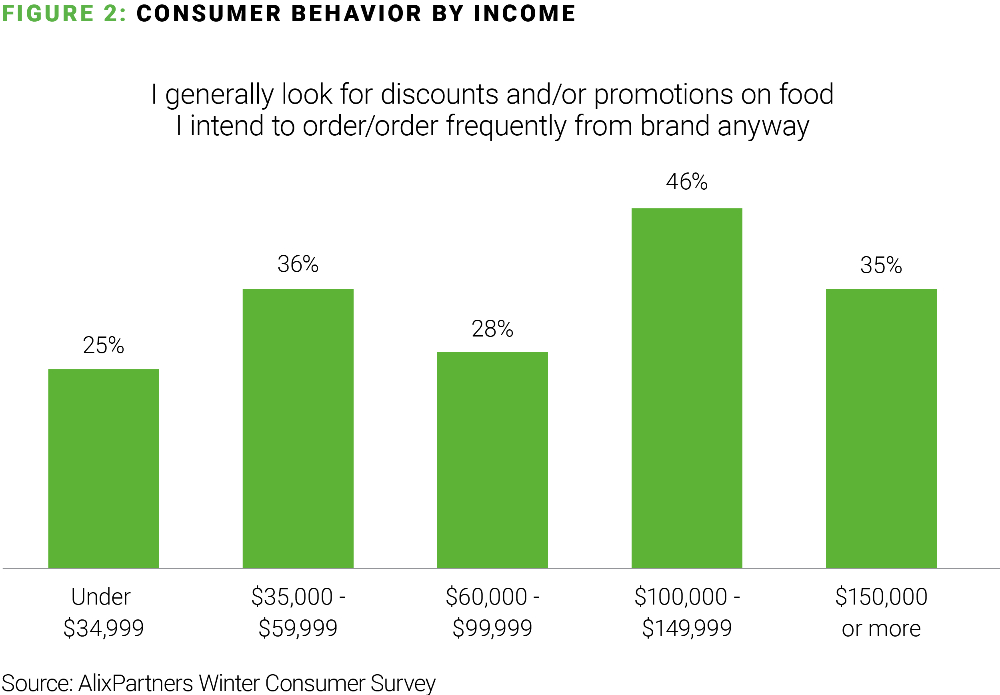
- 30% indicated they were actively seeking promotions from brands they already planned to visit; we see this trend across income levels, notably at higher-income
These behaviors reflect structural affordability pressure, not temporary caution.
Brands have responded with heavier promotional calendars and more aggressive LTO strategies. Analysis of more than 50 national promotions in 2025 shows that 60% generated temporary traffic lifts during active periods, often around five percentage points above baseline trend. Themed campaigns such as McDonald's’ “Boo Bucket” and “Grinch Menu,” or Burger King’s SpongeBob movie partnership, demonstrated that well-executed promotions can create cultural relevance and short-term demand. However, these gains are episodic. Traffic normalizes once promotions end.
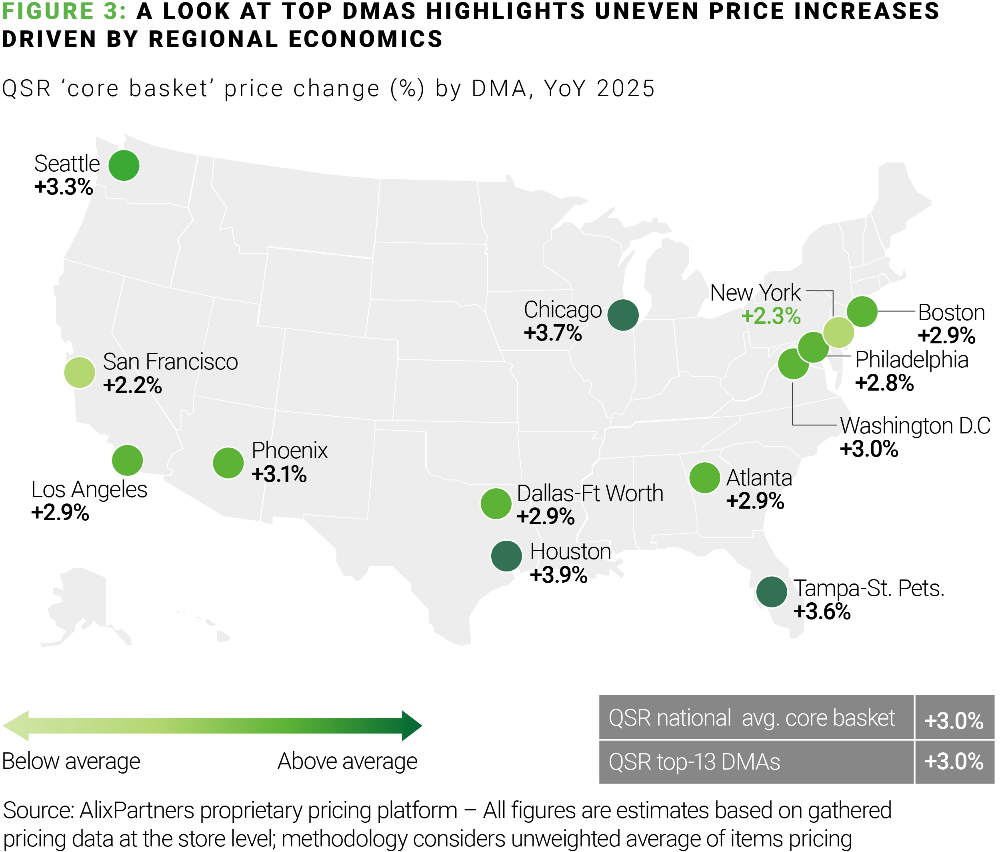
At the same time, national performance averages increasingly mask meaningful local divergence. Our analysis suggests that pricing moves vary across major DMAs and even within sub-DMAs, reflecting differences in competitive intensity, income mix, cost structures, and trade-area dynamics; however, analysis shows no consistent correlation between year-over-year price changes and traffic outcomes. Yet many brands continue to rely on national pricing architecture that assumes demand elasticity is the same everywhere.
The implication is clear: over-reliance on price increases and national promotions is not sustainable. Future performance will depend on localized, analytically grounded pricing strategies reinforced by disciplined execution at the store level.
What must change
First, value must be redefined. Lowering price alone will not restore traffic if execution, quality, or convenience fall short. Consumers evaluate value as a combination of price, experience, and product integrity. Brands must therefore revisit their consumer understanding, who they are pricing for, what occasions they are serving, and what trade-offs customers are willing to make; to identify local-level price points that move demand and engineer the menu to reach them.
Second, promotions must be repositioned as tactical tools rather than structural levers. Continuous discounting is often a symptom of underlying demand softness. Without rigorous measurement, guardrails, and clear objectives, promo-driven volume compresses margins and distorts mix while failing to build sustainable loyalty. Promotions should support strategic priorities—innovation, new customer acquisition, competitive defense—not compensate for structural pricing gaps.
Third, pricing must reflect local market realities. Divergences across and within DMAs demonstrate that performance is inherently local. A one-size-fits-all national price can leave margin untapped in resilient markets and exacerbate traffic declines in pressured ones. Brands need the flexibility and analytical discipline to calibrate pricing market by market, grounded in competitive positioning and local demand elasticity.
Finally, pricing cannot be separated from execution. Store-level speed of service, accuracy, consistency, and digital integration determine whether customers perceive overall value. Weak execution reduces willingness to pay; strong execution reinforces brand equity and pricing credibility. Sustainable pricing power depends as much on operational excellence as on numerical adjustments.
How to rebuild the pricing engine
Winning requires moving from national promo dependence to market‑by‑market pricing discipline, grounded in analytics to understand local dynamics and customer behavior, all reinforced by in-store execution. The ultimate goals are to restore value and shift from temporary promo lifts into sustainable traffic and profit.
There are a few pieces to this strategy.
Know the customer: Segment consumers with similar behaviors, by leveraging AI and machine-learning tools, identifying “personas”, and develop pricing strategies according to the dynamics within those segments (occasions, demographics, value drivers, customer lifetime value), and to evaluate role-based menu architecture (i.e., what are the right basket builders and entry-pricing).
Localize structural pricing with advanced analytics: Restaurants have to build dayparts specific competitive maps, benchmark by item role, and identify potential sub-segments of their customers at the regional level. These insights can allow operators to shift from national averages to localized, data-driven decisions, and model market-specific scenarios to determine potential impact.
Embed rigorous execution and governance: In the new paradigm, companies will link pricing processes, roles, and admin/ownership, to forecasting and other parts of the company strategy and outlook. They’ll treat pricing as a continuous test-and-learn system, not an annual reset, and measure the impact of pricing and promotion decisions in traffic, sales, mix, and margin. In local markets, they will develop a collaborative approach to support in-store execution with franchisees.
The content of this article is intended to provide a general guide to the subject matter. Specialist advice should be sought about your specific circumstances.
[View Source]

