

- within Technology, Privacy and Intellectual Property topic(s)
- in Turkey
Manufacturing a safe product is riddled with obstacles—especially if the product is innovative or includes new or novel design elements. In addition to the business challenges of bringing a new design to market, the development of effective warnings for a product with a new design is fraught with pitfalls. Not only should a manufacturer anticipate how its product will be misused and warn against it, but it must also be familiar with how other products in the marketplace are used. And, if the manufacturer's product works differently than even a fraction of the market, the manufacturer may need to specifically warn a user of the difference.
A recent Wisconsin decision showcases the pitfalls that manufacturers face when experienced users, accustomed to using competitors' products, begin using products with a different design and provides a good reminder that even clear, complete instructions and warnings may not be enough to prevent accidents and the lawsuits that follow. An overview of the case illustrates the many considerations a manufacturer should incorporate when developing warnings for a new product design.
The Aker v. Good Sportsman Marketing LLC Decision
The Wisconsin Court of Appeals recently reversed a summary judgment win by a product manufacturer and its distributors, keeping them on the hook to face a jury for failure to warn. Aker v. Good Sportsman Mktg., LLC,2026 WI App 3, 2025 WL 3484893. The plaintiff, who fell from a tree while using the manufacturer's tree stand harness system, admitted to ignoring clear safety instructions and misusing and altering the product. An experienced hunter who wrongly assumed the product worked like a competitor's product, the plaintiff convinced the court that the manufacturer and sellers should face trial despite warnings, that if followed, would have prevented the plaintiff's accident.
The Product
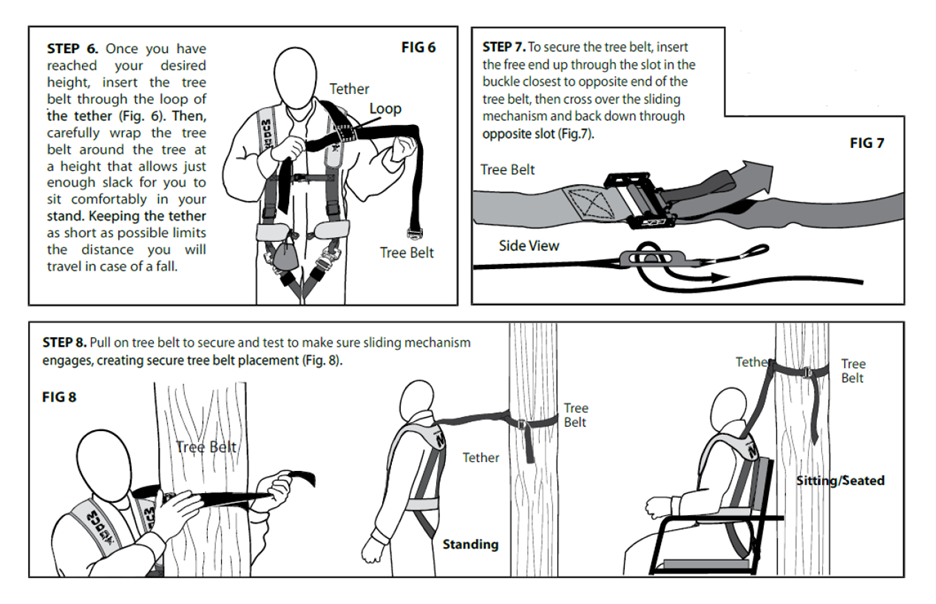
The product at issue in Aker was a"Muddy Outdoors" branded harness system designed for use in an elevated hunting tree stand that included a full-body harness and a tree strap (also called a tree belt). A tether, affixed to the back of the harness, was designed to secure the harness (worn by the user) to the tree strap (attached to the tree). A loop at the end of the tree strap functioned as a release tab. A user could pull on the loop to release the buckle on the tree strap. Because the loop worked as a release, it was not designed to be weight bearing. The instructions (as included in the court's written decision) showed how users connect the tether to the tree strap:
Product Misuse, Alteration and Resulting Injury
The plaintiff, Mr. Aker, was an experienced hunter and long-time user of tree stand harnesses. He read the instructions of the Muddy Outdoors product once after purchase but never again. Although he had used it several times without incident, Mr. Aker never used it correctly. However, on the day in question, Mr. Aker used a carabiner (a metal loop often used by climbers)—which did not come with the Muddy Outdoors product—to connect the harness tether to the tree strap release loop. Where things went wrong for Mr. Aker is that he "should have threaded the subject tree strap through the loop on the tether, rather than using a carabiner to connect the tether to the [tree strap's] buckle release loop." Id.,¶ 8.
Unfortunately for Mr. Aker, he fell out of the tree stand after falling asleep and was injured. Unfortunately for the Muddy Outdoors manufacturer and its distributors, this accident prompted Mr. Aker to sue for strict liability and negligent failure to warn under Wisconsin law.
Warnings Development and Admissions on Product Use
Ample evidence unfavorable to Mr. Aker's claims emerged in depositions. Good Sportsman Marketing, the designer and manufacturer of the Muddy Outdoors product, testified it hired a third-party human factors expert when drafting the instruction manual and product warnings. This included a warning on the harness that explained that failure to read and follow the instructions may lead to serious injury or death.
There was also no evidence that the defendants making and selling the Muddy Outdoors product had any reports of similar misuse or incidents involving use of carabiners with the product. Things looked good for the Muddy Outdoors defendants who had presented undisputed evidence of its careful warnings development and the lack of notice of similar misuse or incidents.
Further, in Mr. Aker's deposition, he acknowledged it was a bad idea to modify components that came with the harness system and admitted to regularly using the harness system with a tree strap from a different manufacturer. When shown the instructions, he agreed they were clear on the correct way to use the harness and unequivocally did not call for the use of a carabiner.
Despite this evidence, the Wisconsin Court of Appeals held that summary judgment at the trial court for the Muddy Outdoors defendants was inappropriate. Why?
The Experienced User Paradox
In his deposition, Mr. Aker also testified that as a lifelong hunter he had owned various harness systems over the years—including one from the same manufacturer—and he always used carabiners without issue. He also thought the carabiner was included with the harness system.
More importantly, Mr. Aker's human factors expert opinion resonated with the court. Even though only one-quarter of harness systems on the market used carabiners, the expert opined that the Muddy Outdoors manufacturer should have foreseen users misusing the product this way and affixed a specific warning to the release loop. The expert referred to this phenomenon as "negative transfer": A person misuses a product by applying previously learned behaviors to a different, but functionally similar, product. Manufacturers must "anticipate the environment which is normal for the use of [the] product," including "all reasonable uses and misuses" of the product and "the resulting foreseeable dangers." Id., ¶ 32.
A Warning for Manufacturers
Aker is a reminder for manufacturers of the difficulties of getting product warnings right, and—if facing a suit in Wisconsin on failure to warn—the challenges of beating the suit by motion before trial. Even here, where the plaintiff modified the product and ignored instructions, and where this was the sole instance of injury, the court held that the case could only be resolved through a trial, and not by summary judgment.
The case provides a few takeaways for product manufacturers doing business in Wisconsin:
- Be familiar with similar products in the marketplace. If your product works differently than even a fraction of the market, you may need to specifically warn a user of the difference. The Aker court noted that a manufacturer must foresee "all reasonable uses and misuses" when developing product warnings.
- Beware of the experienced user paradox: Courts accept that a very experienced product user (like Mr. Aker) may refuse to take time to learn a new system and instead rely on past know-how. This phenomenon has implications for warnings development, including new or improved designs of a crowded field of products.
- Wherever possible, place specific warnings on a product itself where it is most likely to cause danger if misused.
- If sued in Wisconsin, anticipate that defending a failure to warn claim may take you through trial. Even a manufacturer who has done almost everything right may not be able to get a case dismissed on summary judgment.
The content of this article is intended to provide a general guide to the subject matter. Specialist advice should be sought about your specific circumstances.

