

The Case of the "Angel's Hepburn Time" Restaurant
The iconic actress Audrey Hepburn passed away in 1993. A Chinese restaurant named "Angel's Hepburn Time" thought it had found a clever way to evoke an aura of timeless elegance. Founded in 2004, it used Audrey Hepburn's name and images across its storefront, official website, and social media for commercial promotion from 2014 onwards.
They landed themselves in legal quagmire. In a landmark ruling, Chinese courts sided with Hepburn's son, Luca Dotti, ordering the restaurant to immediately stop using the name "Audrey Hepburn," issue a public apology, and pay 200,000 RMB in compensation.
Hepburn's son sued the restaurant for injunction and compensation. The restaurant contended that Hepburn passed away many years ago, and her personality rights have thus lapsed. Her son does not possess the legal standing to claim such rights. The use of the term "Hepburn" constitutes legitimate use and does not amount to tarnishment. Moreover, they voluntarily ceased using the portrait of Hepburn during the litigation and should therefore not be held liable for compensation.
The court reasoned that the name "Hepburn" had formed a stable, unique correspondence with the actress in the minds of the Chinese public. Its commercial use, without authorization, misled consumers into believing a specific connection existed, thus infringing upon the posthumous personality interests of the deceased celebrity.
This case is a clear signal of China's strengthening legal framework for protecting personality rights and combating unfair competition.
Posthumous Rights and the "Right of Publicity" in Civil Code
The ruling in the Hepburn case is firmly grounded in China's Civil Code, which came into effect in 2021.
Article 994 is the cornerstone: It explicitly states that the
name, portrait, reputation, honor, privacy, and remains of the
deceased are protected by law. When these are infringed upon, the
spouse, children, and parents of the deceased have the right to
request the infringer bear civil liability.
Standing to Sue: The right to protect these interests is granted to
close relatives. As one legal analysis notes, this is similar to an
inheritance relationship, where the closest relatives
"inherit" the right to safeguard these interests.
However, this right is not perpetual; it generally does not extend
indefinitely to all descendants to prevent impossible litigation
scenarios, such as those involving figures like Confucius.
From Personality to Property: While the personality rights
themselves cannot be inherited, the economic benefits (property
interests) derived from them can be enjoyed by the successors. In
the Hepburn case, the court recognized that her name and image held
significant commercial value, which her son, as a close relative,
was entitled to protect.
The Expanding Scope of Protection: From Silhouettes to AI Voices
Chinese judicial practice demonstrates that protection extends beyond the literal, unauthorized use of a name, image or likeness. The key legal test is identifiability.
Recognizable Silhouettes: In a case involving a famous
entertainer, a company used a processed silhouette of the celebrity
in a promotional article with suggestive text. The court held that
even though facial features were obscured, the silhouette's
contour and hairstyle, combined with highly suggestive textual
clues, allowed the public to identify the individual. This was
sufficient to constitute a portrait right infringement.
AI-Generated Voices and "Deepfakes": With emerging
technologies, Chinese courts are applying the same principles. In a
typical case released by the Supreme People's Court, companies
were held liable for using AI to synthesize and commercialize a
voice actor's voice without permission. Similarly, a software
company that used a person's portrait in an AI
"face-swap" application for paying members was found to
have infringed portrait rights.
The Unfair Competition and Trademark Dimension: "Free-Riding" and Brand Confusion
Using a celebrity's identity often intersects with unfair competition and trademark law, aimed at preventing consumer confusion and protecting honest business practices.
The Anti-Unfair Competition Law (AUCL): Revised in 2025, the
AUCL prohibits unauthorized use of another's name (including
abbreviations, trade names, etc.) or personal name (including pen
name, stage name, online pseudonym, translated name, etc.) with a
certain influence, likely to result in confusion with another's
goods or association with that other party. Admittedly, Audrey
Hepburn's Chinese name qualifies.
Parallels with Trademark and Brand Protection: The PRC Trademark
Law bars registration and/or use of personal name and images as
trademark if they fall under any of the following
circumstances:
Infringing upon prior rights including name and image as
personality rights etc.;
Being deceptive and likely to mislead the public regarding the
source of goods or services;
Being detrimental to socialist morals or customs, or having other
adverse effects
Stay Clear of Infringement
To mitigate legal risks, businesses operating in or with China should adopt the following compliance strategies:
Conduct Thorough Due Diligence: Before launching a campaign,
brand, or product name, conduct searches beyond just trademarks.
Consider whether any element—a name, a stylized image, a
silhouette—could be identified with a specific living or
deceased celebrity, domestic or international.
Secure Explicit, Written Authorization: Always obtain licenses from
verified rightsholders. For deceased celebrities, identify the
legitimate rights-inheriting relatives or the estate management
entity. Do not assume that lack of response or historical inaction
implies consent.
Respect the Line Between Tribute and Exploitation: Using a
celebrity's name or image in a non-commercial, artistic, or
editorial context may have different legal considerations
(potentially falling under fair use, or reasonable use). However,
any direct or suggestive commercial use is high-risk without
permission.
Be Cautious with New Technologies: Exercise caution when using AI
tools to generate voices, images, or videos. Ensure the training
data and outputs do not appropriate the identifiable features of
real individuals without consent.
Monitor the Legal Environment: Stay informed about updates in
Chinese judicial interpretations and guiding and typical cases
released by the courts in China and particularly the Supreme
People's Court, as they provide the best guidance on how laws
are applied in practice.
Common Pitfalls and Proactive Measures for Businesses
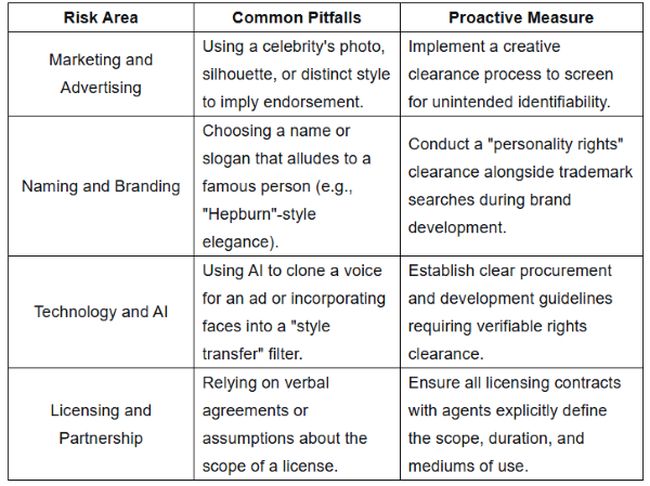
The Audrey Hepburn Legend Lingers On
The Audrey Hepburn case is a powerful reminder that in China, the commercial value and dignity associated with a person's identity do not simply vanish. They are protected by a robust and expanding legal system encompassing the Civil Code, the Anti-Unfair Competition Law, the Trademark Law and a proactive judiciary.
For the business community, the message is clear: strategic brand building must replace opportunistic "free-riding." In today's China, investing in original creativity and securing proper licenses is not merely a legal formality but a critical component of sustainable and reputable market operations. The risks of infringement—financial penalties, injunctions, reputational damage, and costly litigation—far outweigh any short-term gains from unauthorized association.
Licensing or co-branding should be considered as solutions for the rightholders and businesses to enter into a win-win collaboration, expanding and growing business together for mutual benefits.
This article was first published on IP LINK.
The content of this article is intended to provide a general guide to the subject matter. Specialist advice should be sought about your specific circumstances.
