

The IKEA case
In this article, we discuss an interesting EU case that brings together trade marks and politics. What more could we ask for?
Immigration
... is a significant topic in Europe. In Belgium, one of the political parties engage in this debate is Vlaams Belang, which translates roughly as 'Flemish Interests'. The party is known for their very strong views on immigration-related matters.
Controversial branding
In 2022, Vlaams Belang presented a campaign called the "IKEA-PLAN – Immigratie Kan Echt Anders" ("Immigration Really Can Be Different"). . This initiative feature the well-known IKEA trade mark and branding. The campaign was presented in the typical style of an IKEA assembly manual which includes the colours blue and yellow, a chunky typeface, and simplified cartoon figures.

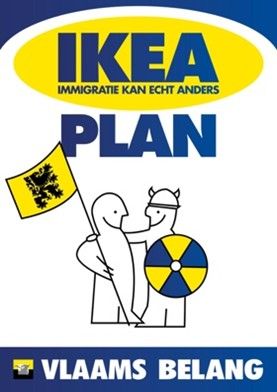
An objection
It was no surprise when IKEA objected to the use of its trade mark and branding. IKEA claimed that the use of its trade mark and branding amounts to trade mark infringement, as well as taking unfair advantage of IKEA's existing and well-established reputation. The case went to the Brussels Business Court. Here's the citation: Inter IKEA Systems v Algemeen Vlaams Belang Case C-298/23.
Freedom of political expression
At the Brussels Business Court, IKEA argued that Vlaams Belang's use of the IKEA trade mark and branding took unfair advantage of their reputation. IKEA claimed that the use of IKEA's trade marks in a political campaign qualifies as 'use in relation to goods or services'. The case triggered a broader legal question at European level, and the Brussels Business Court referred this to the Court of Justice of the European Union (CJEU). The question is whether political parody can constitute "due cause" for using a trade mark without consent under EU trade mark rules and, if so, which factors will guide such an assessment.
Advocate General's opinion
To help the CJEU reach its conclusion, the Court's Advocate General, Maciej Szpunar, issued an opinion. Here are the AGs main points:
- A political programme is not, in itself, goods or services.
- Yet organising an event under that sign, or affixing the sign to objects for distribution to supporters, as well as advertising, can constitute use 'in relation to goods or services'.
- Free political debate is 'an essential element of any democratic society".
- Freedom of expression alone does not automatically justify using a famous trade mark without permission, especially when the use is unrelated to the brand's goods or services and relies on the brand's reputation to draw attention.
- Freedom of expression can only qualify as due cause if it is directed at the trade mark holder and relates to the trade mark itself. Put simply, political parody is not a free pass.
This is not the final ruling. But it does suggest that using a well-known trade mark for political messaging without justification could harm a brand's reputation. Even if people know the party isn't officially connected to IKEA, being linked to a controversial campaign could still affect how the brand is perceived.
The CJEU
We end off with some of the observations that have been made by various parties while waiting for the ruling from the CJEU:
Trade marks in political contexts: 'If the CJEU ultimately agrees with the Advocate General, well-known trade marks could defend themselves beyond the commercial arena, in political contexts. Political parties, activists, or commentators would face stricter limits on using trade marks without permission, whether for satire, criticism, or simply attention, strengthening brand protection.'
Borrowing from other sources: 'The reality is that political campaigns increasingly borrow from advertising, branding, or even songs from famous artists, using familiar elements, humour, or nostalgia to connect with their audiences. The question is how far the law will allow such uses.'
Trade marks will go beyond the marketplace: 'The upcoming CJEU judgment will be closely watched. If the Court sides with the Advocate General, trade mark owners will gain stronger legal grounds to prevent unauthorised uses in political or ideological contexts... regardless of the outcome, it is clear that trade marks are increasingly used for humour, criticism, or other purposes, and owners can no longer assume their marks appear only in the marketplace.'
The content of this article is intended to provide a general guide to the subject matter. Specialist advice should be sought about your specific circumstances.
