

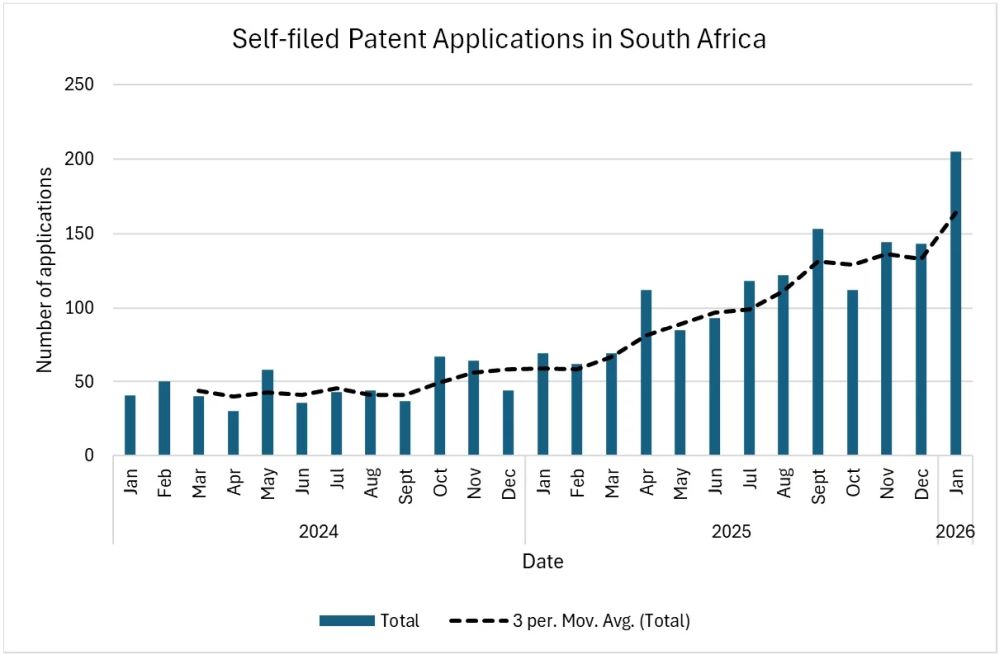
Something remarkable is happening at the South African Patent Office. For years, the number of provisional patent applications filed directly by inventors-without a patent attorney-held steady at around 40 to 50 per month. Then came 2025, and the numbers started climbing. By September 2025, self-filed applications had surged to 153 in a single month. January 2026 saw a record-breaking 205 applications. What's driving this sudden wave of grassroots innovation?
You Can File a Patent Yourself-Did You Know?
Many South Africans are surprised to learn that you don't need a patent attorney to file a provisional patent application. The law allows any person-whether an individual inventor, a small business owner, or someone tinkering in their garage-to submit a provisional application directly to the Companies and Intellectual Property Commission (CIPC). This gives you twelve months of protection (with an optional three-month extension available in South Africa) to develop your idea, test the market, or seek investors, all before committing to the more complex and costly complete patent application.
This is precisely what hundreds of South African inventors are now doing. The question is: why now?
The ChatGPT Effect
There's an elephant in the room, and it's powered by artificial intelligence. The explosion in self-filed applications coincides almost perfectly with the widespread adoption of generative AI tools like ChatGPT, Claude, and others. These tools have made it dramatically easier for ordinary people to draft technical documents, structure their ideas coherently, and navigate bureaucratic processes.
A review of the applications themselves reveals a striking pattern. Many of the invention titles read with a distinctive, almost formulaic sophistication. Consider filings such as "AI-Powered Holistic Bereavement Support and Insurance Claims Integration Platform" or "System and Method for Objective-Constrained Multi-Channel Message Generation with Compliance Gating, Semantic Cross-Validation, Cryptographic Referral Attribution, and Bounded Engagement-Driven Regeneration". These elaborate, jargon-rich titles suggest that AI tools are helping inventors articulate their concepts in patent-style language.
There's something democratising about technology that helps ordinary people participate in a system previously accessible mainly to those who could afford professional help. But it does raise important questions about what comes next.
The Allure of Saving Money
The most obvious appeal of self-filing is cost. A patent attorney will typically charge several thousand rand to prepare and file a provisional application—a significant barrier for inventors with limited resources. Self-filing through the CIPC costs only the small official filing fee.
This makes sense at the provisional stage, where the legal stakes are lower. A provisional application is essentially a placeholder: it establishes your priority date and gives you breathing room to decide whether to pursue full protection.
What Are South Africans Inventing?
The self-filed applications reveal a fascinating snapshot of South African innovation.
Mobile apps and digital platforms dominate, with applications for taxi-hailing, transport management, payments, and delivery tracking. Titles like "Namela Taxi App" and "Smart Taxi Dispatch, Payment, and Compliance Management System" reflect deep engagement with everyday South African challenges-particularly informal public transport.
Fintech and financial inclusion is another major theme, with systems for digital payments, stokvel management, and mobile banking. Titles like "Lobola Insurance System and Method for Cultural Marriage Obligations" speak to uniquely South African needs.
AI-powered solutions appear with striking frequency. Inventors are incorporating artificial intelligence into everything from medical diagnostics to agricultural management and even aromatherapy.
Safety and security devices feature prominently-personal security apps, emergency alert systems, anti-theft devices, and drone-mounted security systems-reflecting South Africa's particular concerns.
Green energy is a growing category, with inventions for solar power, water filtration, and off-grid solutions.
And there's a delightfully eclectic mix of household inventions: resealable beverage cans, bread slicers, and even "gender-inclusive multi-functional boxer briefs".
The Catch: What Happens at the Complete Stage?
Here's where things get complicated... A provisional patent application buys you time, but it doesn't give you an enforceable patent. To obtain actual patent protection, you must file a complete patent application within 12 months (or 15, with the extension). And here's the crucial point: a complete patent specification must be signed by a registered patent attorney.
This is where self-filers may encounter difficulties. The complete application requires a properly drafted specification with claims that define the scope of your monopoly. These claims must be drafted with precision-too narrow and you won't catch copycats; too broad and they may be invalid.
Moreover, the quality of your provisional application matters more than many inventors realise. The complete application can only claim priority from the provisional if the invention was adequately described. If your provisional omitted important technical details, your complete application may not fully rely on your earlier priority date-fatal if a competitor has filed something similar in the meantime.
This is the hidden risk. Generative AI produces text that sounds impressive, but it doesn't know what a patent specification needs for robust protection. A title like "Blockchain-Based Barcode Verification System Using Non-Fungible Tokens" sounds sophisticated, but whether the description supports valid claims is another matter.
What Should Self-Filers Do Next?
None of this is to say that self-filing is a bad idea-for many inventors, it's a sensible first step. The key is understanding what still needs to happen. If you've filed a provisional and want proper protection, the clock is ticking. Your twelve months (or fifteen with the extension) will pass quickly, and you'll need a patent attorney to review your filing, assess whether your invention is adequately described, and prepare a complete specification with properly drafted claims.
At Adams & Adams, we work with inventors at all stages of the patent process. Whether you've self-filed and need help completing your application, or you're considering filing for the first time, we're here to assist.
A New Era of South African Innovation?
The surge in self-filed applications is a hopeful sign: more South Africans than ever are recognising the value of intellectual property and taking steps to protect their ideas. Technology has lowered the barriers, and people are responding.
But innovation without protection is just an idea waiting to be copied. If you've taken the first step, make sure you take the second. Your invention deserves it.
The content of this article is intended to provide a general guide to the subject matter. Specialist advice should be sought about your specific circumstances.
