

In April 2026, Taylor Swift’s company, TAS Rights Management, filed three new trade mark applications with the United States Patent and Trademark Office ("USPTO"), seeking to protect both her spoken voice and a distinctive visual image from the Eras Tour. The filings, which include two “sound marks” (Taylor speaking the phrases "Hey, it's Taylor Swift," and "Hey, it's Taylor") and a visual trade mark (shown below) represent the most ambitious attempt yet by a celebrity to deploy trade mark law as a shield against AI-generated deepfakes.
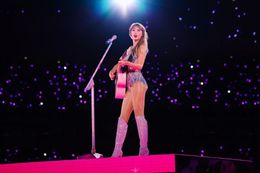
*Image credit: USPTO
Swift’s strategy is not without precedent: in March 2026, 19-year-old darts sensation, Luke Littler, applied to the United Kingdom Intellectual Property Office ("UKIPO") to register his face as a trade mark and actor Matthew McConaughey has similarly filed to protect his likeness at the USPTO. Together, these developments raise important questions about the scope and limitations of trade mark law as a tool for protecting personal identity.
The Littler application
Luke Littler rose to prominence in 2024, aged 16, when he won the BBC Young Sports Personality of the Year Award. In January 2025, aged just 17, he became the youngest ever darts world champion after defeating three-time champion Michael van Gerwen. He repeated the feat in January 2026, defeating Dutch player Gian van Veen 7–1 in the final. His image now appears on a wide range of branded products, from dartboards and video games to bags of nuts, and he has already secured trade mark protection for his nickname “the Nuke” in the United States.
Littler’s trade mark application is part of the broader trend exemplified most prominently by Swift. In October 2025, Chelsea footballer Cole Palmer trade-marked his autograph, facial image, and the term “Cold Palmer”. McConaughey has secured eight trade marks at the USPTO, including a sound mark of his iconic catchphrase “Alright, alright, alright”. These developments reflect growing concern within the entertainment and sports industries about the unauthorised exploitation of personal image through AI-generated content.
What does a facial trade mark actually protect?
It is important to be clear about what trade mark registration does (and does not) achieve. A registered trade mark does not confer a general right to prevent all reproduction of one’s face. Rather, it prevents the unauthorised commercial use of the registered mark in relation to the specified goods and services.
Trade mark registrations are also an important aspect of licensing deals, as it gives the celebrity a tangible asset around which commercial arrangements can be structured.
Littler’s decision has been widely characterised as a shrewd branding move. The legal framework around AI and copyright is still evolving, but trade marks remain one of the most effective tools available to control commercial use.
The South African position on personality rights
In addition to trade mark rights, South Africa provides substantive protection for personality rights. South African courts have consistently held that the unauthorised use of a person’s image for commercial purposes without consent constitutes an infringement of personality rights. Nevertheless, as South African law does not recognise any specialised proprietary rights regarding image, nor property rights in a person’s image, likeness, voice, or other aspects of their persona, celebrities and sports stars have increasingly registered themselves as trade marks to secure broader commercial protection.
The European Position: Lessons from Puck Schrover
The European Union Intellectual Property Office (EUIPO) has grappled directly with the question of whether a face can function as a trade mark. In April 2023, PS Holding BV filed an application to register the face of Dutch model Puck Schrover as a figurative trade mark in classes 35 and 41, covering modelling and promotional services.
In September 2023, the EUIPO Examination Division refused the application, holding that the mark lacked distinctive character.
PS Holding BV appealed, and the decision was overturned. The application subsequently proceeded to publication and was registered.
The Clarkson confusion
Similar questions have arisen in the context of Jeremy Clarkson, with many suggesting that he has sought to register his face as a trade mark. However, this characterisation is likely an oversimplification. What Clarkson may in fact be seeking to protect are more specific figurative marks, for example, a stylised depiction of his face as used on Hawkstone products, imagery associated with Clarkson’s Farm, or a consistent caricature used throughout his branding. These are more conventional applications of trade mark law, and should be distinguished from an attempt to register one’s unadorned face per se.
This distinction is important. It is far more straightforward to register a stylised or caricatured image of a face, which has been processed or illustrated in a manner that renders it distinctive, than a standard photographic portrait. Celebrities have historically found greater success with trade mark applications involving:
- caricatures or illustrated portraits;
- signature imagery used consistently across a brand; and
- artwork or design elements that form part of a recognisable personal brand identity.
It bears noting that these more conventional trade mark types (brand names, logos, slogans, and stylised signatures) remain far more common than facial registrations, and face fewer obstacles to registration.
Taylor Swift: Expanding the playbook to voice and image
As introduced above, Swift’s April 2026 filings mark an expansion of trade mark strategy into new territory that few before her have attempted (but almost certainly many are likely to follow). Two of the three applications are “sound marks” covering Swift saying the phrases “Hey, it’s Taylor Swift” and “Hey, it’s Taylor”. The third seeks to protect a specific visual image: a photograph of Swift on stage during her Eras Tour, holding a pink guitar and wearing an iridescent bodysuit with silver boots.
Swift’s filings are noteworthy for several reasons. First, the attempt to register a celebrity’s spoken voice as a trade mark represents a novel use of trade mark law that has not yet been tested in court. Historically, singers relied on copyright law to protect their recorded music. However, AI technologies now permit users to generate entirely new content that mimics an artist’s voice without copying an existing recording. This is a gap that Swift is trying fill with her trade marks. By registering specific phrases tied to her voice, Swift could potentially challenge not only identical reproductions but also imitations that are “confusingly similar”, a key standard in trade mark law that provides broader protection than copyright’s requirement of actual copying.
Second, the filings illustrate the breadth of the deepfake threat that celebrities now face. Swift has been a prominent target of AI misuse. In January 2024, AI-generated sexually explicit images of her circulated on X (formerly Twitter), with one post reportedly viewed over 47 million times before being removed.
Swift’s strategy builds upon that of McConaughey, who earlier in 2025 secured eight trade marks at the USPTO, including a sound mark of his iconic catchphrase “Alright, alright, alright” (a personal favourtie!). Together, these filings are testing new theories on how trade mark law will function in the AI age. If successful, the sound marks could theoretically allow Swift to claim that any AI-generated use of her voice that sounds like the registered trade mark violates her rights. Similarly, that AI-generated images of her in a bodysuit with a guitar infringe the visual trade mark.
The scale of Swift’s trade mark portfolio is itself instructive. She now holds over 300+ trade mark filings in the United States alone, covering everything from her name and album titles to specific song lyrics such as “This sick beat” and “We never go out of style”. This comprehensive strategy serves to reinforce her brand and create multiple layers of legal protection. The April 2026 filings represent the extension of that strategy into the protection of personal identity attributes.
Why trade mark a face? The commercial rationale
Notwithstanding the challenges, the commercial rationale for registering a facial image as a trade mark is compelling.
Registration not only provides a mechanism for commercial control, but also securing additional revenue streams (typically where a celebrity’s image appears on merchandise, advertising, or promotional material)
In addition, in an ERAS (sorry, I couldn’t help myself) of personal branding, trade mark registrations provide the tools to prevent imitations or confusingly similar depictions.
The limitations of trade mark law in combating deepfakes
It must be acknowledged that trade mark law is, at best, an imperfect tool for combating AI-generated deepfakes. Trade mark protection is limited to unauthorised use “in the course of trade” in relation to the specified goods and services. It does not capture non-commercial uses, satirical or editorial depictions, or AI-generated content that falls outside the scope of the registered classes. Even if applications are successful, trade mark protection is confined to particular classes of goods and services and is therefore not a silver bullet against deepfakes.
Conclusion
The trend towards registering facial images, voices and personal likenesses as trade marks reflects a real and growing need: in the age of generative AI, personal identity has become both more commercially valuable and more vulnerable to exploitation. The approaches of Littler, McConaughey, and Swift demonstrate that trade mark law is being pressed into service in novel ways to fill the gaps left by copyright and the absence of comprehensive personality rights legislation.
The content of this article is intended to provide a general guide to the subject matter. Specialist advice should be sought about your specific circumstances.
[View Source]