

- within Media, Telecoms, IT and Entertainment topic(s)
- within Government, Public Sector, Tax and Strategy topic(s)
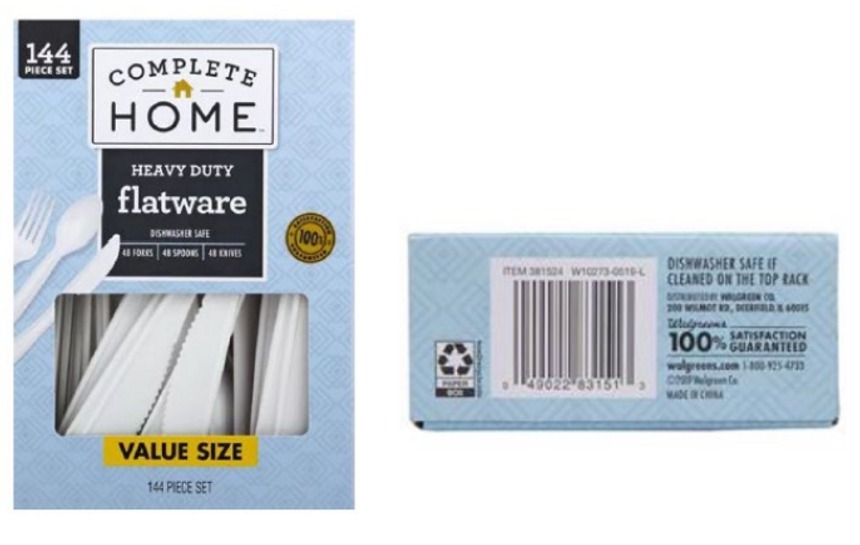
Walgreens sells Complete Home Heavy Duty plastic cutlery. The front and the back of the packaging are labeled "DISHWASHER SAFE" and "HEAVY DUTY" in all caps. On the bottom of the box, however, there's a disclaimer that says, "DISHWASHER SAFE IF CLEANED ON THE TOP RACK." Was it deceptive for Walgreens to prominently promote that its heavy duty plastic cutlery was "dishwasher safe" while only disclosing the limitations on the bottom of the box? That was the issue in a recent case in federal court in Illinois.
In the lawsuit, the plaintiff alleged that the phrases "dishwasher safe" and "heavy duty" are misleading, since they communicate that the cutlery can be washed anywhere in the dishwasher. She argued that this is particularly relevant here, since a dishwasher's cutlery basket is ordinarily located on the bottom rack of the dishwasher. She sued, alleging that when she washed the cutlery in her dishwasher, it melted!
The plaintiff asserted a variety of false advertising-related claims under California law, and Walgreens moved to dismiss. In order to survive a motion to dismiss, the plaintiff must sufficiently allege that the advertising misleads a "reasonable consumer." Under California's reasonable consumer standard, a plaintiff must show that members of the public are "likely to be deceived."
Walgreens argued that no reasonable consumer could be misled by the "dishwasher safe" claim because the bottom of the box does explain that it is only dishwasher safe when washed on the top rack. Walgreens also argued that it didn't claim on the packaging that the product was safe for the bottom rack.
The court allowed the case to continue, holding that the plaintiff had sufficiently alleged that the front label of the packaging was unambiguously deceptive to a reasonable consumer. The court explained, "taking all inferences in favor of the Plaintiff . . . a reasonable consumer would look at a box of 'heavy duty' plastic cutlery labeled as 'dishwasher safe' on the front and take it at its word."
The court also didn't think that the fact that a disclaimer appeared on the bottom of the box necessarily cleared up any confusion here. Citing the 9th Circuit, the court explained, "a disclaimer on the back label of a package is not necessarily sufficient to dispel the deception caused by a misleading statement on the package's front."
What's the lesson here – other than to wash your plastic cutlery in the top rack? If you've got important information to convey to consumers, don't hide it!
Simpson v. Walgreen, 2026 WL 413565 (N.D. Ill. 2026).
The content of this article is intended to provide a general guide to the subject matter. Specialist advice should be sought about your specific circumstances.
