

Duane Morris Takeaway: This week's episode features Duane Morris partners Jerry Maatman and Jennifer Riley and associates Ryan Garippo and Elizabeth Underwood with their discussion of the key trends and developments analyzed in the 2026 edition of the TCPA Class Action Review.
Check out today's episode and subscribe to our show from your preferred podcast platform: Spotify, Amazon Music, Apple Podcasts, Podcast Index, Tune In, Listen Notes, iHeartRadio, Deezer, and YouTube.
Episode Transcript
Jerry Maatman: Welcome, loyal blog listeners and readers. Thank you for being here for our weekly podcast of the Class Action Weekly Wire. I'm Jerry Maatman, a partner at Duane Morris, and joining me today on the podcast are my colleagues Jennifer Riley, Elizabeth Underwood, and Ryan Garippo. Thanks all for being here.
Jennifer Riley: Thanks, Jerry, it's always good to be here.
Elizabeth Underwood: Thank you, Jerry. Happy to be part of the podcast.
Ryan Garippo: Thanks for having me, Jerry.
Jerry: Today on the podcast, we're discussing a recent publication of the Duane Morris Class Action Defense Group called the TCPA Class Action Review – the Telephone Consumer Protection Act. Listeners can find this e-book publication on our blog, the Duane Morris Class Action Defense Blog. Jen, can you tell our listeners a little bit about this desk reference?
Jennifer: Absolutely, Jerry. So, the TCPA has long been a focus of litigation, particularly for class actions. The class action team at Duane Morris released its third edition of the TCPA Class Action Review earlier this week. The publication analyzes the key TCPA-related filings and rulings and developments in 2025, as well as the significant legal decisions and trends impacting this type of class action litigation for 2026. We hope that companies will benefit from this resource in their efforts to comply with these evolving and ever-changing laws and standards.
Jerry: In 2025, I think it's fair to say that courts issued a mixed bag of results and rulings on issues arising under the TCPA, sometimes for the defense, sometimes for the plaintiffs. Ryan, overall, how often were plaintiffs' classes certified in TCPA lawsuits?
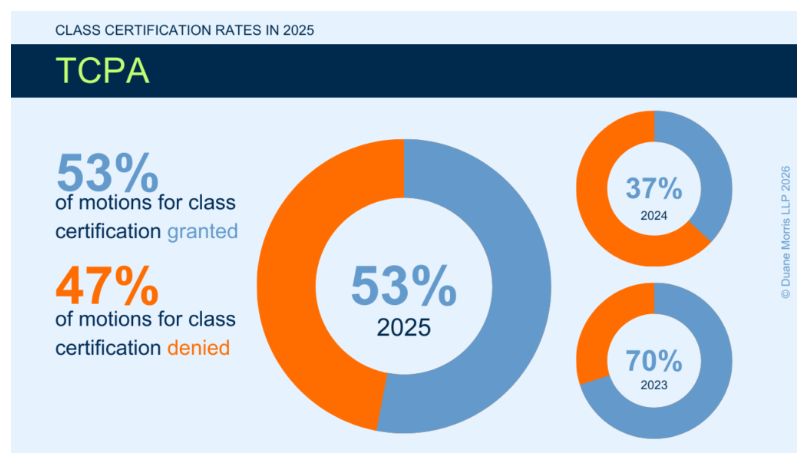
Ryan: Well, Jerry, I would say there were wins on both sides, but plaintiffs came way ahead in terms of having classes certified. Courts granted motions for class certification in 53% of cases and denied them in 47% of cases in 2025. However, that's higher than in 2024, when courts granted certification in 37% of the time, however, much lower than in 2023, when the plaintiffs' bar was much more successful in obtaining class certification, with courts granting such motions upwards of 70% of the time.
Jerry: Well, for those keeping a scorecard, those are certainly up and down results that swing from year to year. Elizabeth, in terms of your thought leadership in following this area, what, to you, were the most notable rulings in this space in 2025?
Elizabeth: Yes, Jerry, in Fischbein v. IQVIA Inc. A federal court in Pennsylvania denied class certification in a TCPA fax case – and the decision turned on old-school technology. The proposed class included more than 25,000 healthcare providers who allegedly received unsolicited fax advertisements. But the court closely examined the TCPA's language and concluded that the statute only protects faxes received on traditional stand-alone fax machines and not modern online fax services. The key statutory phrase was "telephone facsimile machine," which the law defines as equipment that transmits or receives documents over a "regular telephone line." The court interpreted that to mean an analog telephone line, not internet-based fax platforms. The court thus found that the plaintiffs could not show through common evidence which recipients received the faxes on traditional machines versus online fax services. Without a reliable way to distinguish between the two, the court found the class was not ascertainable. And because determining the method of receipt would require individualized inquiries, common issues did not predominate.
For TCPA defendants, Fischbein underscores the importance of scrutinizing class definitions. If liability depends on the method of receipt – traditional fax machine versus online service – and that distinction can't be determined through common proof, that's a powerful argument against certification.
Jerry: Well, thanks so much, Elizabeth. I think another important TCPA ruling this past year emanated from the Third Circuit in Conner v. Fox Rehabilitation Services. In that case, the Third Circuit affirmed a district court's denial of class certification in a TCPA case involving facsimiles. The key issue there was consent. Ryan, how do you read that Third Circuit decision?
Ryan: Sure, Jerry. I think it remains true to this day that consent is still the most powerful defense in response to a TCPA case. So, during the early months of the COVID-19 pandemic, Fox Rehabilitation sent more than 20,000 faxes to healthcare providers, promoting its therapy services, while also reassuring providers that it remained operational. The plaintiff alleged that the faxes were unsolicited advertisements in violation of the TCPA and sought to certify a class. The district court actually denied certification there, finding that individualized questions regarding whether each recipient had consented would overwhelm the common issues. Although the court later ruled for the plaintiff in his favor at a bench trial on the individual claim, but that said it did not allow the case to proceed as a class. On appeal, the Third Circuit clarified one important point: although the class was ascertainable, because it could be identified using the defendant's own facts transmission logs, that wasn't enough. The Third Circuit agreed that consent would require individualized inquiries regarding how and when each recipient provided their fax number, and when the faxes fell within the scope of that consent. Because these individualized issues predominated over the common ones, the Third Circuit affirmed the denial of class certification, reinforcing what has been traditionally known that consent is the most powerful barrier to a TCPA case.
Jerry: Thanks, Ryan. I agree that consent issue tends to be a very good weapon in the arsenal of defendants to try and block or fracture classes in this space. I suspect we're going to see that issue playing out in other circuits in 2026. Jen, the review also, analyzes the top settlements in this space, and it seemed like plaintiffs did very well this year in monetizing their class action settlements and TCPA cases.
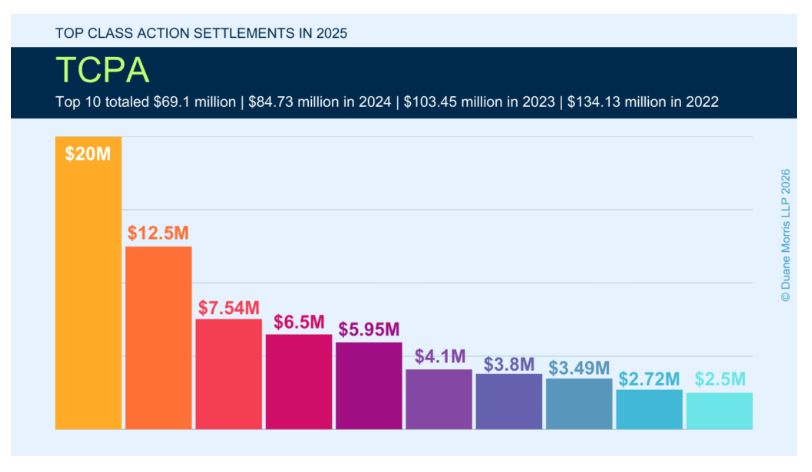
Jennifer: Agreed, Jerry. Plaintiffs did very well in securing high-dollar settlements in 2025 in the TCPA space. The top 10 TCPA class action settlements totaled $69.1 million. That's down just slightly from what we saw in 2024, where the top 10 settlements totaled $84.73 million.
Jerry: As our loyal readers know, we track the settlements on a 24/7/365 basis, so we'll be analyzing top TCPA class action settlements throughout the year. Well, thank you very much for being here on today's podcast, and thank you for our loyal listeners and readers for tuning in.
Jennifer: Thanks, Jerry, and thanks to all of our listeners. We hope you enjoy the TCPA Review. Please stop by the blog and download your free copy of the e-book.
Ryan: Thanks so much for the opportunity, Jerry.
Elizabeth: Thanks for having me, Jerry, and thank you to all the listeners.
Disclaimer: This Alert has been prepared and published for informational purposes only and is not offered, nor should be construed, as legal advice. For more information, please see the firm's full disclaimer.
[View Source]


